Showing posts with label business. Show all posts
The 4-Hour Workweek: Escape 9-5, Live Anywhere, and Join the New Rich
Whether you are an overworked employee or an entrepreneur trapped in your own business, this book is the compass for a new and revolutionary world. Join Tim Ferriss as he teaches you:
• How to outsource your life to overseas virtual assistants for $5 per hour and do whatever you want
• How blue-chip escape artists travel the world without quitting their jobs
• How to eliminate 50% of your work in 48 hours using the principles of a forgotten Italian economist
• How to trade a long-haul career for short work bursts and freuent "mini-retirements"
• What the crucial difference is between absolute and relative income
• How to train your boss to value performance over presence, or kill your job (or company) if it’s beyond repair
• What automated cash-flow “muses” are and how to create one in 2 to 4 weeks
• How to cultivate selective ignorance—and create time—with a low-information diet
• What the management secrets of Remote Control CEOs are
• How to get free housing worldwide and airfare at 50–80% off
• How to fill the void and create a meaningful life after removing work and the office
Ultimately I enjoyed the first half of Timothy Ferriss' book The 4-Hour Work Week. It challenged me to evaluate my perspective on the cost and availability of my own dreams. However I couldn't help getting the self-promotion stomach pangs while I read it. Hopefully you'll be able to look past that and enjoy the book for what it is: a challenge to the way we as Americans think of retirement and money.
The first 70 to 90 pages of the book are extremely engaging and well worth the price of the book. After that the book turns into a "lifestyle-for-dummies" book on setting up a shell company to sell someone else's products. Although I find it noble that Ferriss is attempting to give people pragmatic steps for implementing his "New Rich" lifestyle, I also find his suggestions impractical for two reasons:
* His business ideas rely on tiny, niche audiences. This works well unless his book becomes a best seller and many people decide they want to do the same thing (can you say, We Buy Ugly Houses?). Anyone who figures out how to make 5 or 10 times their money on a product that they exert little effort to produce will quickly find competition popping out of the woodwork.
* His business ideas are not sustainable. They rely on marketing strategies and promotions that have to work forever without any change to profitability or response rates, in order to maintain the "4-hour work week" lifestyle. In my experience the market is fickle and changes frequently, especially as it relates to the internet and online marketing.
I can't help but think that the entire "New Rich" concept is a branding ploy to roll out a series of self-help seminars. Let's hope not. If it does, it will distort the message of the book, for it would require that Ferriss trade in his "New Rich" lifestyle to be back in the rat race on a quest for the millions that he claims are not necessary to achieve one's dreams.
Perhaps that's the real lesson to be learned from the book: no matter where you are, the grass always seems greener on the other side.
Labels: best books, best seller, books review, business, The 4-Hour Workweek
Getting Things Done: The Art of Stress-Free Productivity
This book is for all those who are overwhelmed with too many things to do, too little time to do them, and a general sense of unease that something important is being missed.
Everyone has experienced times when everything seemed effortless, and progress limitless. David Allen has captured ways for you to achieve that wonderful state of mind and consciousness more often.
His key concept is that every task, promise, or assignment has a place and a time. With everything in its proper place and time, you feel in control and replace the time spent on vague worrying with effective, timely action. As a result, the accomplishments grow while the pressure to accomplish decreases. As a result, the book contains many insights into "how to have more energy, be more relaxed, and get a lot more accomplished with much less effort."
The key psychological insight of this book is that rapid progress occurs when you take large, unformed tasks, and break them down and organize them into smaller, sequential steps for exactly what to do and when. The book provides lots of guidance and examples for how to do this.
The book is organized into three sections. The first gives you an overview of the whole process for how to get more done in a relaxed way. The second spells out the details of how to implement that process, in a way that a personal coach might use. The third provides subtle insights that help you appreciate the benefits that follow from using the process. Like all good coaches, Mr. Allen understands that appreciating a subject from several perspectives and getting lots of practice with it are critical steps in learning.
The process advocated by this book is described with lots of systems flow charts that will appeal to all of the engineers and left-brained people. The right-brained people will find lots of discussions about emotions, feelings, and stress. So both types of thinkers should do well with this material.
The essence of the process is that you write down a note about everything when you take on a new responsibility, make a new commitment, or have a useful thought. All of this ends up in some kind of "in" box. You then go through your "in" box and decide what needs to be done next for each item. For simple issues, this includes identifying the action you should take first and when to take it. For tougher issues, you schedule an appropriate time to work the problem in more detail. You organize the results of this thinking, and review your options for what you should be doing weekly. Then you take what you choose to do, and act. Think of this process as the following five steps: (1) collect (2) process (3) organize (4) decide (5) act.
For the tougher problems, you start with identifying your purpose and principles so you know why you care how it all turns out. Then you imagine the potential good outcomes that you would like. Following that, you brainstorm with others the best way to get those outcomes. Then you organize the best pathway. Finally, you identify the first actions you need to take. Then you act, as in step 5 above.
From this outline, I hope that you can see that this is not rocket science. It is simple common sense, but with discipline. The critical part is the discipline because that is what focuses your attention where it will do the most good. For example, rather than sitting on something you have no idea how to get started, you can decide right away to get ideas from others on what the purpose and principles are that should be used in selecting a solution. So, you are in motion, and you have saved much time and anxiety.
What I learned from this book is that many people allow a lot of time to pass without taking any useful steps because they cannot imagine what to do next. This process should usually overcome that problem by showing you what to work on, providing methods to accomplish that step in the process, and guiding you to places where you can get appropriate help. As a result, this book should help overcome the bureaucracy and communications stalls that bedevil most organizations.
This fits from my own experience in helping people solve problems. If you simplify the questions and make them into familiar ones, everyone soon finds powerful alternatives drawn from a lifetime of experiences and memories. Keep things broad, abstract, and vague, and peoples' eyes glaze over while they struggle for a place to begin.
After you have finished reading and applying this book, I suggest that you share your new learning with those you see around you who are the most stressed out. By helping them gain relaxed control of their activities, you will also be able to enjoy the benefits of their increased effectiveness in supporting your own efforts.
May you always get the tools you need, understand what to do next, and move swiftly through timely actions!
Labels: best books, best-seller, business, stress
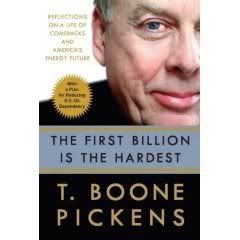
The First Billion Is the Hardest
T. Boone Pickens began at age 11 delivering papers, mowing lawns and pumping gas in Oklahoma to becoming chairman of the BP Capital Management hedge fund. He invested a mere $2,500 into Mesa Petroleum and built it into one of the largest independent oil companies in America and then overcame a time of personal difficulties by taking an investment fund of $3 million and turning it into $8 billion in just a few years. That's why I picked up a copy of Boone's book The First Billion is the Hardest and read it from cover to cover with close attention and fascination. In his book, Pickens presents his plan for America to become energy independent as well as detailing his life of improbable triumphs. The book provides an inside view of his oil and gas career, of mergers and acquisitions, of his dealings with CEOs and investment bankers, and on his personal management style. On energy, Pickens makes the argument that the U.S. cannot drill its way out of our current crisis but must think our way out. In discussing energy solutions, Pickens stresses that crude oil is not used only for gasoline, heating oil and jet fuel but for other important petroleum products such as plastic, synthetic fibers, fertilizers, ink and many more products. For that reason, even if no foreign oil went to energy uses we'd still be beholden to the Middle East. Pickens wants to replace at least a third of gasoline demand with natural gas to reduce our foreign oil bills by 16 percent annually. The book contains 11 chapters on the author's personal insights and experiences, including his insights on energy, and one chapter on his energy plan. While some readers may scoff at the author's folksy personality and "Bonneisms" the fact is that T. Boone Pickens has 60 years experience in the energy field - experience that gives him credibility and suggests we should listen closely when he speaks. The book also provides an interesting peak into how Pickens spends his money - a philanthropic approach to use his money to perpetuate helping others. In fact, the author shares his intent to give away all of his money and how he will do it. But before he could give away as much he has, Pickens first had to earn his fortune and The First Billion is the Hardest is a fascinating and compelling story of how that was done.
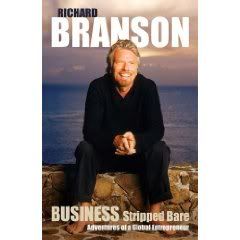
Business Stripped Bare: Adventures of a Global Entrepreneur
"...enjoy your life. You only get one." If you have read previous Sir Richard Branson's books; you have read most of it already. However, this book, "Business Stripped Bare: Adventures of a Global Entrepreneur", Sir Richard Branson focused solely on the business side of his life. Actually, all his life is about business! Unlike other business book writers, he has the first-hand experience in Virgin. In this book, he covered lots of topics. A quote from the book "So all I can do for you now (and I firmly believe that this is all anyone can honestly do) is map the territory I've seen. The good news is, I've covered a lot of territory."
Contents - Introduction
- People: Find Good People - Set Them Free In this chapter, he generally wrote about the culture in Virgin.
- Brand: Flying the Flag Richard Branson wrote exclusively on Virgin Blue in Australia and how he fought hard to beat the competition and established the Virgin brand there.
- Delivery: Special Delivery Among other things, he started the chapter with Virgin Trains and how it reshaped the industry in UK. He moved onto how he run Virgin Records and how he started Virgin Mobile in UK and in the US.
- Learning from Mistakes and Setbacks: Damage Report Failure to acquire the bank, Northern Rock, is the focus of this chapter. Richard Branson is also subjected to mistake and he wrote on how to bounce back.
- Innovation: A Driver for Business Virgin Galactic is going to be huge and tell me after you read this chapter that you don't want to travel into space!
- Entrepreneurs and Leadership: Holding on and Letting Go He wrote about his experience with Nelson Mandela and how he set up Global Elders to tackle the humanity issues around the world.
- Social Responsibility: Just Business This chapter is fantastically inspiring. He separated it into two parts. The first is about his activities to relieve Africa from HIV and Aids. He also wrote about Bill Gates and how they shared philanthropy to make the difference in the world. The other part is the climate change issue. You heard it all before but instead of pouring fear to you, Richard Branson offers you hope.
- Epilogue: Success ... This book is not written as an autobiography. I think of an ideal business book and I'll compare Business Stripped Bare to it; a book that is easy to read, distinct, practical, credible, insightful, and provides great reading experience.
Ease of Understanding: 8/10: Richard Branson wrote it in plain language and make the readers follow him easily. The drawback of the book is that sometimes, the issues jump back and forth from mobile to records to airline to health clubs to finance and so on! Anyway, the part on Virgin Galactic (the rocket science) is not rocket-scientifically difficult to understand!
Distinction: 7/10: Although his life experience is one of its kind, there are other books on this already namely "Losing My Virginity" and "Screw It, Let's Do It" by... Richard Branson...! However, the way he explained the general ideas of people, innovation, brand, etc (the usual business terms) through his experience is unlike those typical business books that litter these contents with figures, theories, graphs, models, metaphors and so forth.
Practicality: 5/10: Richard Branson offers no solid steps to encourage people, enrich brand, turbocharge delivery, foster leadership, and so on. He believes that everyone has his/her own story and way. He did not say that following him is the best approach to business but he made you think of your own. However, his general comments (with his experience as the credentials) are valuable and you cannot really dispute them.
Credibility: 10/10: His ideas are proven; people, brand, delivery, leadership, and so on. He made it work. Where is the better place to find the idea of business and entrepreneurship other than the words of one of the greatest global entrepreneurs?
Insight: 7/10: Although Richard Branson do not describe the ideas of innovation, brand, people, social responsibility with academic researches and scientific findings, he wrote it from his experience which is more valuable than most researches. Not that researches are insignificant but his life should be taught as a module in business schools. But if you already read his other books, this book will offer you only few new contents.
Reading Experience: 10/10: This book is like a journey into one of the most adventurous businessmen in the world. Like he said, the book (his life) covers a lot of territory. If you like reading other people's life, there is no better person to read than Richard Branson. This book is like an adventure that it starts out with serious business contents with sparks of excitement and ends with good causes and social responsibility that we can make a difference not on but to Earth.
Overall: 7.8/10: This book is encouraging; it encourages you to go out and start a business. This book is motivating, it motivates you to make your business exciting. This book is inspiring; it inspires you to make you business meaningful and virtuous. This book will not make you want to be Richard Branson but it will make you want to have a great business life. This autobiographical business book is for everyone who loves business. If you have read Richard Branson's book before, do not expect it to be something totally new. If you have not, I don't see a reason why shouldn't you give it a try.
100 Essential Steps to Career Success
Sometimes, the most profound truths are contained in simple quotations. This book really made me think about how I handle different situations on a daily basis. If you are interested in self-improvement, buy this book and follow the principles. The techniques are very practical and can be followed to improve both your personal and professional life.
No matter who you are or what your situation you will get something out of reading this book. It encourages the reader to learn to seek and enjoy change. Overall, this book is a very enjoyable read. The style of the book is so good you can't put it down once you start reading it. The pictures ensure the phrases are easy to recollect. You will want to pass this on to friends and colleagues after reading!
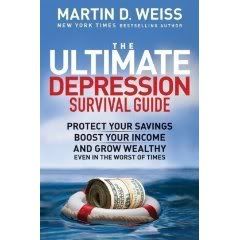
The Ultimate Depression Survival Guide
This comprehensive guide was especially designed to help people map out a practical financial plan in this unpredictable economic environment, so that they can stop worrying about their money and just enjoy life. Step by step, Martin Weiss--America's Consumer Advocate for Financial Safety--introduces, explains, and helps solve many of the new challenges and risks that face millions of Americans. Throughout the book, Weiss provides readers with sound strategies for coping with the credit crunch, housing bust, and decline of the U.S. dollar. The Ultimate Depression Survival Guide also examines important topics that today's investor must be familiar with--including global investing, foreign currencies, and commodities--if they intend to make it through the decade ahead.
I've been a fan of the Weiss Publications for many years so wasn't sure this book would have anything new to offer. So often, the books published by those with ongoing newsletters or other online services tend to be increasingly shallow, reprints of information you have encountered repeatedly or-- worse of all -- shallow promotional tools hyping the sale of their expensive products or service subscriptions. While the author does indeed have many information products including newsletters etc...he refrains from watering down his content Or shameless promotional efforts throughout. Instead, he delivers delightfuly fresh content, easy to read and relevant. I read a lot of business books...in fact, I teach business/finance etc at the college level, write and consult on the topic so I'm always in the middle of reading at least one (or more) business books. Here are a few things that set this one apart from the rest...
1. The author is unapologetic about his position. In fact, he publishes his email and contact information right up front so you can write or comment.
2. Accessible. This book is reader friendly and designed to appeal to a wide audience. The advice is do-able and can be easily modified to fit any budget...this is not a book only for those with massive portfolio's searching for a bigger/better return but truly a survival manual. Those with little money concerned how they will cover the basics are likely to find as much value in the book as those nearing retirement watching their 401k or other investments shrink in recent years.
3. Practical. The advice is meant to take action on...not sell you the next level. Likewise, the information is different from that of the newsletters although regular readers of Martin Weiss will be pleased to find it consistent with his core suggestions and outlook.
Bottom line...whether you grow wealthy or simply preserve your standard of living while others sink this book is well worth the time and effort to review.
Outliers: The Story of Success
Malcolm Gladwell poses a more provocative question in Outliers: why do some people succeed, living remarkably productive and impactful lives, while so many more never reach their potential? Challenging our cherished belief of the "self-made man," he makes the democratic assertion that superstars don't arise out of nowhere, propelled by genius and talent: "they are invariably the beneficiaries of hidden advantages and extraordinary opportunities and cultural legacies that allow them to learn and work hard and make sense of the world in ways others cannot." Examining the lives of outliers from Mozart to Bill Gates, he builds a convincing case for how successful people rise on a tide of advantages, "some deserved, some not, some earned, some just plain lucky."
Spoiler alert! This book contains about a dozen "whoa, amazing" nuggets that could change your life, or at least tell you why you never changed your life, and I'm going to include all of them here just to have them listed somewhere convenient online for my benefit (and yours). But as any Gladwell fan knows, you don't read his writings just for the "holy cow" moments, you read them for the journey he takes you on in delivering those moments. This work provides several amazing journeys, even as they stray progressively farther from what seems to be the advertised purpose of the book: to illustrate how certain people become phenomenal successes. We learn early on the secret to being a great Canadian hockey player, assuming you are already spectacularly talented and work hard. But eventually we wind up learning not how to become a spectacularly successful airline pilot, but rather a spectacularly bad one. No bother, the book is providing entertaining information that can transform your professional life. So as for those dozen points, here goes, and you've already been warned: 1. There was a town in Pennsylvania called Roseto where people lived far longer and suffered far less from heart disease than people of similar genetic stock, eating similar diets, and living in similar nearby towns. The only explanation researchers could find was that Roseto had a uniquely strong sense of community: family and faith were both strong, and the wealthy did not flaunt their success. 2. In the Canadian "all star" junior hockey league - the surest ticket to the NHL - the majority of the players on the winning team were born in January, February, or March. The league was for players between 17 and 20 years old. Why the month anomaly? Because in Canada, elite hockey teams have try-outs at the age of 10, and the age cut-off is January 1. In essence, the oldest 10 year olds are far better at hockey than the youngest 10 year olds, so the youngest (those born in December) have no chance to make the select teams, which are the only ones with excellent coaching. The pattern continues all the way through high school. Similar birthday patterns are seen in places such as the Czech junior national soccer team. Makes you wonder about what "good for your age" means in academics too. 3. Many researchers believe in the "10,000 hour rule," namely that you need to spend about 10,000 hours on a skill - anything, including music, computer programming, business dealings in the expanding American West, or mergers and acquisitions - in order to become great at it. This is something Bill Gates and the Beatles have in common, thanks largely due to circumstances beyond their control. 4. At least 15 of the wealthiest 75 people in world history (in modern dollars) were born in the 9 years from 1831 to 1840. They were old enough to have learned how to profit in the rapidly industrializing United States (via 10,000 hours of experience) but not so old as to have already settled down and been inflexible with their life options or concepts of business. Similar birthdate "coincidences" are seen among the wealthiest tech entrepreneurs including Bill Gates, and among some of the most successful lawyers in New York. 5. In long-term studies, IQ is found to predict professional success - but only up to a score of about 120, past which additional points don't help. Nobel prize winners are equally likely to have IQs of 130 or 180. When minority students are admitted through affirmative action, their achievement scores may be lower, but as long as they are above the threshold, it does not affect the likelihood of professional success. 6. Anecdotes from the "world's smartest man," (according to IQ tests) Chris Langan, and the children of middle class families, suggest that "practical intelligence" about when, how, and with what words to speak up are a huge factor in success - specifically when speaking up can save you from losing a scholarship. Longitudinal studies of high-IQ children showed that a family's high socioeconomic background was more important to predicting success than very high IQ. 7. Many people put in their 10,000 hours in something like computer programming, but then never find themselves in the midst of a revolution where people with 10,000 hours of experience are desperately needed. Bill Gates did. The connections he formed as an early highly-sought programmer helped him rise and found Microsoft. Joe Flom, one of the most successful lawyers in New York, became a specialist in mergers and acquisitions before such transactions were considered "acceptable" business by mainstream lawyers. When the culture changed in the 1980s to accept such dealings, Joe Flom was the best of the best who had put in his 10,000 hours in a now-mainstream business. He became an historic success almost overnight. 8. When economically tough times hit, people stop having children for fear of being unable to provide for them. However, this may be the best time to have children, because there are few other children competing for things such as classroom attention, spots on school sports teams, professors' attention, and jobs upon high school or college graduation. There are also more children a decade behind them who will provide the demand for the goods and services the older children will provide. 9. The typical airline crash involves seven consecutive human errors, and crashes are significantly more likely to occur when the more-experienced captain is flying the plane, as opposed to the subordinate first officer. The likely reason is that the first officer is much less likely to speak up when he or she notices something wrong or a human error, and the captain is flying the plane. Flights in countries with a large "power distance index," which characterizes cultures where subordinates are generally afraid of expressing disagreement with superiors, are the most likely to crash. This included Korean air, which had the worst safety record among major airlines until it instituted a program requiring subordinates to speak up when there were problems. There are benefits to deferential, polite, and subtle conversation, but they are unlikely to be beneficial in stressful cockpit environments. 10. There are at least two non-genetic reasons Asian people excel at math (and some tests have suggested that Asians may have genetic _disadvantages_ in math). First, most commonly used Asian languages use a monosyllablic, ordered, regular system to describe numbers, unlike English and European languages. This gives young children up to a year's head start in math. Second, math often requires persistence and trial and error, characteristics also needed for successful rice farming, the dominant form of agriculture (and employment) in Asia even in the 20th century. Hilarious evidence of correlation of persistence with high math scores is found in results on the TIMSS, an international math exam. The beginning of the exam includes a tedious 120-question section that asks students about their parents' education, their friends, and their views on math, among other things. It is exhausting, requiring great _persistence_, and some students leave it partially blank. If you rank countries by how many of the survey questions their students completed, and by the TIMMS score, the lists are "exactly the same." Holy cow! At the tops of both lists were Singapore, South Korea, China (Taiwan), Hong Kong, and Japan. 11. Students from middle class and poor neighborhoods show an achievement gap in reading that widens over the years of elementary school. However, the financially poorer students progress (in terms of grades on standardized tests) the _same_ amount during the _academic_ year as the wealthier students. It is during the _summer_ break that better-off students with better-educated families continue to read and learn, while the less well-off students likely do not, and show major declines in autumn test scores compared to the previous spring. Students in "KIPP" (Knowledge Is Power Program) schools showed major success despite coming from low income neighborhoods, because of a much longer school day and academic year. 12. The author, Malcolm Gladwell, tells a story in the final chapter about how his family, and thus he, benefitted from light skin tones and changing racial attitudes in Jamaica. It's a stretch compared to the rest of the book, but gets you thinking and is an awkwardly charming read.
Labels: books, books review, business, Outliers: The Story of Success
Subscribe to:
Posts (Atom)