Showing posts with label parenting. Show all posts
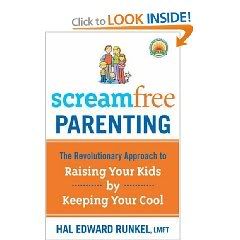
Screamfree Parenting: The Revolutionary Approach to Raising Your Kids by Keeping Your Cool
"ScreamFree Parenting," by Hal Runkel, is an excellent parenting guide that will help moms and dads everywhere to keep (or regain) their sanity. Runkel is a licensed family and marriage therapist and one of the founders of ScreamFree Living, Inc. The book's thesis is that parents cannot keep tabs on their kids 24/7, nor can they force their children to consistently behave in a certain way. Therefore, mothers and fathers would be better off learning to focus on how they react to their children's words and actions.
Parents, Runkel contends, should take stock of themselves. Are they in control of their behavior when they interact with their children? Or are they at the mercy of their "emotional reactivity"--their unthinking, knee-jerk reactions? If the latter is true, it is likely that parent-child interactions will be tense, angry, and unproductive.
All of us who have struggled with parental responsibilities instinctively realize that a calm and reasoned approach is far more effective than a hysterical and dictatorial one. However, because of fatigue, ignorance, or inertia, many of us instinctively lash out, saying things that we don't really mean when our kids push our buttons. What to do?
Runkel does not advocate a permissive parenting style. Rather, the author recommends what he calls "judo parenting." Judo is "the art of going with another's momentum." A ScreamFree parent facilitates rather than dictates; he encourages his children to use their own resources to solve problems. By helping kids to get in the habit of making their own decisions and living with the consequences, parents will be more likely to launch "self-directed" adults.
Runkel's writing style is clear, concise, humorous, and to-the-point. The book is conveniently divided into easy-to-read sections and the chapters all conclude with thought-provoking "reflection questions." The author provides many practical examples to demonstrate how his principles work in the real world. Runkel's amusing quotations from a wide variety of sources add liveliness to his message. In additon, there are lengthier anecdotes that are taken from Runkel's experiences as a family therapist. Most parents will pick up many useful tips from "ScreamFree Parenting." It is an entertaining, intelligent, and practical approach to raising our kids without losing our minds.
Labels: best books, books review, discipline, family, parenting
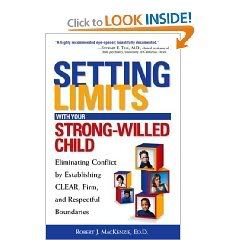
Setting Limits with Your Strong-Willed Child : Eliminating Conflict by Establishing Clear, Firm, and Respectful Boundaries
As a step parent of a very "Spirited" and "Strong-Willed" child, I can acknowledge first hand that the methods and philosophy of this book WILL promote harmony and cooperation. Maybe not initially but certainly in the long term. "Setting Limits" deals with discipline issues associated with the nine temperamental traits: 1.Persistance, 2.Intensity, 3.Regularity, 4. Distractability, 5.Energy and Activity Level, 6.Sensitivity, 7.Adaptability, 8.Reactivity, and 9.Mood.
The author is also the parent of two children, one compliant, easy going, and the other one strong-willed/demanding so he can relate with the parents who scream, "nothing works with this kid!".
This book is NOT about harsh punishement but rather teaches respectful limit setting, which is an essential teaching tool. It teaches parents to give children clear, respectful messages to convey the necessary information for the child to make acceptable choices. To focus on the behaviour in a way that does not belittle, criticize or shame the child. Although parents may genuinely feel that they are giving a clear "Stop" message to their child, they are sometimes unwittingly giving a yellow or even green light to unwanted behaviours. The strong-willed child interprets these vague massages as "Optional requests" or learns only that the behaviour upsets or angers the parent. This may lead to increased limit testing to see where the boundaries really are, especially if they enjoy making us jump and yell. It sometimes seems that Strong-willed children need to learn everything the hard way by agressivly testing all limits or restrictions (much more than compliant children) to see where the bottom line really is. They are aggressive researchers who leave parents little room for ineffective discipline. There is not much to prepare a parent for dealing with a strong-willed child, and unfortunately they tend to bring out the worst qualities in parents. A child that can argue and debate like a courtroom attorney, develop sudden hearing loss, or dawdle until you are late for work. Parents easily fall into ineffectual ruts of predictable reaction based on our own upbringing and parenting assumptions.
The good news is that the solution usually involves doing much less than what the parent is probably doing at present. You must accept and acknowledge that this is part of the childs personality/temperament, and that they will always need a little more structure and consistancy than compliant chidren. It does not mean they can't learn to cooperate and observe family rules. This book shows parents how and "WHEN" to negotiate rules, what behaviours should be ignored, which ones must be corrected and most importantly "How to do it!".
The most impressive part of all the books I've read by Robert J MacKenzie, is the weath of realistic examples. Every point is thoroughly illustrated for clarity, with discipline scenarios which all parents can readily idenetify with. There are sections on motivating your strong-willed child, encouraging independence, teaching skills, and role-modeling
The entire book is aimed at teaching your child self control. Some books on the challenging children seem more focused on avoiding conflict and undulging the child, which might be great for the short-term, but how can it possibly prepare the child for the real world.
I would also highly recommend reading the book "The Manipulative Child: How to Regain Control and Raise Resilient, Resourceful, and Independent Kids" by Swihart and Cotter.
Out of the dozens of parenting books I've read, "Setting Limits" is certainly one of the best written and sound discipline books for strong-willed children.
Labels: best books, family, parenting, Setting Limits
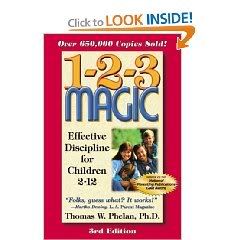
1-2-3 Magic: Effective Discipline for Children 2-12
Tom Phelan has indeed written a sensible, easy to read, discipline book that clearly explains his 1-2-3
Magic theory designed for parents of tots-gradeschoolers. As a veteran preschool teacher, many of the parents of my own students over the years have found success with Phelan's techniques. However, some conscientious but frustrated moms and dads admitted to me that they found themselves between a rock and a hard place as they reached '2 and 3 quarters', '2 and 7 eighth's', etc ...unable to change the behavior of their sometimes annoying, disrespectful, uncooperative kids. Not to
worry...Although your career as a magician may fall short of your goal, you are not doomed to be labeled an ineffective disciplinarian. It has been my experience, both as a parent and teacher, that there is no one single discipline approach that works every time, for every kid in every family. Although I
totally respect 'the count' in this book, I strongly encourage parents to seek out an assortment of strategies that for whatever reason might be a better fit at a particular moment, in respect to age, personalities and parenting style. If you have young kids (2's, 3's 4's,and 5's) who are literally driving
you towards your wits' end with such things as their bad words, 'I hate you's', hitting, whining, parent deafness, tantrums, lying, 'gimmes', mealtime and bedtime refusals, I suggest checking out "The Pocket Parent", a quick read A-Z guide, loaded with hundreds of fast answers and tips to try. The bullets of information (called 'sanity savers') are written
exclusively for preschool behavior and are based on a solid philosophy that maintains a real sense of concern for the needs and feelings of both children and their parents. I highly recommend both books for a variety of workable discipline options that parents (and preschooler teachers) can choose from while trying to remain sane in the process!
Labels: 2-12, best books, best-seller, children books, parenting
How to Talk So Kids Will Listen & Listen So Kids Will Talk
If I could entice every new parent to read just one book, this would be it. Thousands of children's lives have been improved, and in some cases transformed, as a direct result of their parents reading this book and practicing its kid-tested, nonpunitive approaches to discipline. The authors have little time for abstract theorizing, concerning themselves with down to earth practical issues of parenting, using sensitivity, empathy, communication skills, and humor. This book is crammed with invaluable suggestions, techniques and ideas for parents committed to raising great kids without resorting to discredited, harmful, pain-and-fear-based methods of the past.
This book is in its twentieth edition for a reason: these methods WORK. I personally know a mother who formerly used the harsh, punitive methods of James Dobson, only to find that her problems with her daughter became worse and worse over time rather than better. After she read "How To Talk So Kids Will Listen And Listen So Kids Will Talk" and put its suggestions into practice, she literally threw Dobson's volume into the trash. And after a year and a half, she told me her relationship with her daughter had improved so much that she'd previously had no idea that it COULD be that good. The fact that the problems she'd been having had vanished now seemed almost an afterthough compared to the deepening of their parent-child bond. Their communication had improved profoundly, opening up previously unguessed levels of richness in their relationship. "She is such a terrific kid," my friend once told me, and with genuine incredulity added, "I can't believe I actually used to HIT her!!"
Another acquaintance of mine, who is raising two great kids using nonpunitive methods of the sort Faber and Mazlish recommend, summarized her entire philosophy in just one sentence: "I don't want obedient children, I want COOPERATIVE children!" I think the great majority of parents, if they thought about it, would realize that this is what they too would prefer. Faber and Mazlish show the way.
This book appears at first glance to be a collection of nonpunitive discipline techniques, but it is actually much more: a whole new way of thinking about the parent-child relationship which transcends the permissiveness vs strictness continuum with an approach to parenting based on neither punishments nor rewards. Authoritarian methods use coercion to make the child lose and the parent win, while total permissiveness makes the parent lose and the child win. Faber and Mazlish's methods, on the other hand, show the way towards families in which everybody wins.
Labels: best books, books, books review, family, parenting
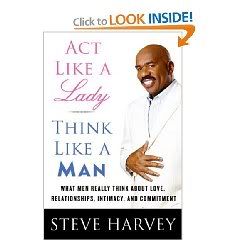
Act Like a Lady, Think Like a Man
"Filled with practical principles, rules and tips, and illustrated with humorous and warm-hearted anecdotes from Harvey's life and friendships, ACT LIKE A LADY, THINK LIKE A MAN gives readers the real deal about the differences between the sexes and how to bridge them for a mutually rewarding partnership." (New York Beac).
Women can sit around with our girlfriends talking about how much men don't make sense or how they won't act right, but we oftentimes find better advice by actually asking for advice from our guy friends. The only problem is our guy friends may lie to spare our feelings, but Steve Harvey is not trying to be our friends and he's telling it like it t.i.s. in his new book, "Act Like a Lady: Think Like a Man: What Men Really Think About Love, Relationships, Intimacy, and Commitment."
Harvey breaks down all of the things that women need to know about men in 15 chapters on relationships--mama's boys, marriage, whether we are the ones for men to sports fish (reel in and throw back into the water when they're done) or a keeper; when we should introduce men to our child(ren); why the 90-day rule for sex makes sense; how independent women can remember to be ladies; the three things that drive men (who they are, what they do, and how much they make); and why "We need to talk" is a phrase that is man's worst enemy.
There are some contradictions within the read, like why women need to get out of the 1945 mentality of waiting on men to marry them, but at the same time, sticking to the chivalrous expectations of letting him open doors, wearing heels, carrying heavy items and letting him fix things and paint. (However, I interviewed him for the "Chicago Defender" [article will be out in February sometime] and he explained why he felt some old-fashioned values should still be met. His analysis made sense too.)
But for every contradiction, there are lessons that make so much sense. Harvey has a point. Women are far more complex with their emotions than men are, judging from his research and his own opinions and observance from my own friends. Poet Maya Angelou said it best when saying "When someone shows you who they are, believe them." That was the main theme throughout Harvey's read--to set standards and stick to them. While some men may feel like Harvey is snitching, women like me finished the read feeling educated and confident in my past decisions. Excellent and quick read, but grab your highlighters and take noteson ).
Labels: Act Like a Lady, best books, books review, parenting, Think Like a Man
Subscribe to:
Posts (Atom)