Russell Shorto's The Island at the Center of the World is a chronicle of the early years of Manhattan, when it was known as New Amsterdam and was a relatively short-lived Dutch colony. According to Shorto, this period in New York history has not only been given short shift by historians, but also is crucial to understanding the development and character of New York City and the United States. Shorto believes that most students of United States history have assumed that New York City's history only really got underway when the English took over and instilled some order.
This is due in part to the disdain that the British held for the Dutch, and to the fact that the subsequent histories of the United States were told from their biased perspective. However, Shorto demonstrates that New Amsterdam was a viable society of its own, and that its unique character among the early American colonies had a remarkable impact on the future United States. For Shorto, as the first "multi-ethnic, upwardly mobile society on America's shores ... Manhattan is where America began."
Shorto is not a professional historian, but rather a professional writer, and he is writing for a popular audience. As a result his work flows in a novelistic manner, with vivid descriptions, imaginative poetic license, interesting asides, informal language and even bawdy humor used to liven things up. His acknowledged inspiration is the late Barbara Tuchman, whose meticulously researched books set a standard for bridging the gap between dense scholarship and popular appeal. Indeed, she managed to make a bestseller out of a 800+ page book about the 14th century, among other subjects, and Shorto emulates her with a knack for a compelling narrative drawn from myriad primary sources.
In this case, the primary sources are comprised of diaries, court documents, letters and municipal records found all over the world, principally in New York and the Netherlands, which are only recently being given the scholarly attention that they deserve. Shorto describes a sort of renaissance in colonial studies, spurned by a new interest in the Dutch period, and he is admittedly standing on the shoulders of giants, i.e., the professional historians who have let this popular writer have a look at their on-going research. At the center of this scholarship is a 12,000-page trove of documents relating to New Amsterdam, now residing in the New York State Library in Albany after narrowly escaping several brushes with destruction.
Written in dense 17th century Dutch, they are still in the midst of being translated by Dr. Charles Gehring, a specialist in that narrow field. The story of the documents' survival and Dr. Gehring's research is itself very entertaining, and is told breathlessly by Shorto as if he can't quite believe his good fortune at being privy to the them. That Dr. Gehring's work figures so prominently throughout the book is testament both to his importance to the project, and Shorto's debt to him.
Shorto traces New Amsterdam's character, naturally, to Amsterdam and Dutch society. He points out that Dutch society was the most tolerant in Europe at the time, a place where dissidents and controversial thinkers could come to escape persecution. The book is filled with examples of this enlightened atmosphere, from philosophers like Descartes and Spinoza to the interesting fact that one-half of all books in Europe were published in the Netherlands. Fresh from the highly resented imperial rule of the Spanish, the Dutch were particularly sensitive to liberal notions of free-speech and self-determination. Furthermore, Shorto suggests that because New Amsterdam was a company town, and never intended to be a settlement colony, attitudes toward religious and national differences were put aside to a remarkable degree. Business is business, after all, and distractions were unwelcome in this market society.
New Amsterdam was not entirely a reflection of Dutch society, however. Indeed, Shorto points out that because Amsterdam was a pleasant place even for the poor, only the very lowest order of society could be convinced to populate the far-away outpost of New Amsterdam, and thus the city became populated with a particularly rough-and-tumble crowd. Through court records he brings to life some of these figures, and this time spent with various average residents is one of the more delightful aspects of the book. He recounts a lively atmosphere full of drunkenness, casual violence, and casual sex, all of which help to make the book entertaining to a popular audience. He even mixes in a fair amount of humor, such as when he writes of a record concerning a woman who, as her husband sleeps off a drunken stupor, "'dishonorably manipulated the male member' of a certain Irishman while two other men looked on." Shorto can't help himself, and remarks, "Excessive rigidity (of the moral kind) was not the sin of New Amsterdam's residents."
As interesting as it is to read about these forgotten average people, the backbone of the book rests with two more important figures. One is Pieter Stuyvesant, an early governor of the colony, who is well known to modern New York residents due to the fact that streets, squares and apartment complexes have been named for him. His statue can be seen in Stuyvesant Square, and his tombstone is built into the side of St. Mark's-in-the-Bowery church in the East Village. Running in front of that church is Stuyvesant St., still running today in true East-West (at odds with the surrounding grid) as it did in Stuyvesant's time. The other figure is Adriaen van der Donck, an attorney trained in Europe who, for mysterious reasons, turned his back on a prosperous and comfortable life in Holland and took a position in New Netherland.
For Shorto, van der Donck is the true "hero of the story" who has been unjustifiably forgotten by American history; Shorto makes clear that he aims to rectify this lack of recognition.
Both characters are vividly drawn. Stuyvesant is a no-nonsense, autocratic governor hardened by the loss of a leg to a Spanish round in the Caribbean. The pages detailing 17th century amputation techniques, and Stuyvesant's wound festering for nine years in a tropical climate, are quite harrowing, and one is left with no doubt as to why his personality may have developed as it did.
Shorto's narrative structure sets van der Donck in opposition to Stuyvesant; van der Donck is a believer in liberal notions of tolerance, human rights, free speech and representative government who found himself at odds with Stuyvesant's world of absolute rule. Their struggle comprises the central conflict of the book, and Shorto credits van der Donck's (sort of) victory as setting the stage for modern America's recognition of liberal values.
In pursuit of this premise, despite a little bit of hyperbole that pops up in his zeal to "close the deal", Shorto has written a very engaging book with a convincing argument. The modern reader has been deliberately and skillfully engaged by utilizing anachronistic notions like "geopolitical landscape" and even "bar scene." It works: the reader is taken back and asked to imagine New Amsterdam via Shorto's vibrant descriptive ability, and in the process comes to appreciate the binds that tie a long-past society to our own.
The Island at the Center of the World
Mannahatta
This is a heavy and substantial tome (inevitably printed in China - where else?) which details the author's amazing work in reconstructing the stunningly-beautiful natural environment of Manhattan Island in 1609, when the Dutch explorer Henry Hudson and his crew first laid eyes on it.
This much I already knew before purchasing the book, but frankly, I was disappointed when I actually got it. In part this is because the book seems to struggle to decide what it wants to be. A major portion does indeed deal with Manhattan Island in 1609. There are a number of amazing images put together with the latest computer-generated image technology after painstaking field research and with the 18th century British headquarters map. They depict a Manhattan so beautiful it brings tears to the eyes, particularly when you consider how totally the natural environment of the island has been destroyed. Still, I was left only half-satisfied, and would love to have seen something other than simulated aerial views, i.e. some neighborhood by neighborhood ground-level close-ups with descriptions (maybe they exist somewhere, but the link to the [...] website printed on the book's jacket didn't work; perhaps it's not up yet). But apart from reprints of historical paintings and drawings, there is less detail than I would have expected. Nor is there much discussion (apart from references to the laying-out of the grid street-plan and the grading involved) of the Manhattan archeological record, or of the massive and traumatic process of changing the primitive woodland paradise of 1609 into an unrecognizable agricultural and then urban environment. Since the earliest Dutch prints of New Amsterdam in the book already show a treeless tip of southern Manhattan, the colonists clearly wasted no time in proceeding with an aggressive program of land-clearing and filling. Perhaps few records exist, but it would have been interesting to learn more about how this happened, and how the deforestation progressed over the decades. For that matter, the calculated rapaciousness with which the natural environment of Manhattan was destroyed over 3 centuries also gets short shrift; to anyone acquainted with the degraded environment of NY City today & the meager environmental consciousness of its citizenry, Sanderson is oddly optimistic as he compares the 'natural biosphere' of the virgin landscape of 1609 to the 'human biosphere' of Times Square in 2009, and talks enthusiastically about a green NY which sounds more like Portland, Oregon.
Dr. Sanderson also digresses with lengthy chapters best described as philosophical ruminations on the nature of environmental research, the composition of biospheres, and the super-green Manhattan of 2409 (a wildly-optimistic scenario which combines elements of agriculture and a Disney 'city of tomorrow') only indirectly related to recreating Manhattan's lush original environment. The chapter on Manhattan's original inhabitants, the Lenni Lenape indians is fascinating, but only emphasizes how utterly the historical record of these people, who dwelt on Manhattan for hundreds of generations, has been erased.
Fully the last quarter of the book is a series of appendices, some of which are fascinating (catalog of the brooks, streams, and ponds of Manhattan), though one wonders whether so many lists were really needed.
Dr. Sanderson's enthusiasm for his topic comes through loud and clear. I just wish a bit more of it had been translated into the concrete and included in this book.
Red Mars
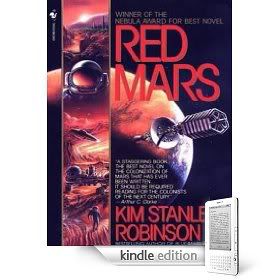
Nominally a future-history of Martian colonization, Red Mars covers the initial 100 Martian colonists, the influx of workers as corporations attempt to exploit the planet's resources, and the consequences as conditions worsen. The book is divided into eight parts, each telling the story from the point of view of one of six characters. Each character is interesting and three dimensional. The first, Frank Chalmers, is a stunning example - a machiavellian sociopath who arranges the murder of his best friend. The book suggests early on that the characters are dysfunctional, but most are not, and Robinson describes each personality in a way that's easy to relate to. Most readers will see some of themselves in every character, and will be moved when many disappear from the story as events unfurl.Robinson's prose is easy to read and descriptive. He lovingly describes the Martian landscape, and the events that change the planet. He explains the processes and technologies being used to make the planet more habitable. Mars and its future is viewed through different cultures and ideologies. And Robinson describes political and social systems evolving, growing, and collapsing - the only challenges the colonists seem unable to solve are those that cannot be fixed technologically. The ending is dramatic and, cheesy last line notwithstanding, overwhelming.A word about the politics: Several reviewers have trouble understanding the concept of sympathetic characters not representing the author. Nobody argues that, through Chalmers, Robinson is advocating murder, so why assume that characters portrayed as idealistic hot-heads advocating an enlightened Utopia (not communism) are attempts to convert readers to Marxism? Robinson's prediction of a near future where a handful of democratically unaccountable transnational corporations wield more power than governments is neither unreasonable nor extremist propaganda nor unique; nor is it that people sick of these conditions might reject them for something Utopian, and might make up a sizable proportion of those wanting to leave Earth. Robinson is describing what might happen and why, rather than pushing a particular ideology. It is notable that the consequences of the actions of most of the first 100 are hardly positive: why would an author promote a vision of an enlightened Utopia by having for it such divided, belligerent, builders?
If Red Mars has faults, they are that it is fairly humourless, and some of the science (nothing, fortunately, important to the principle of convincing the reader that colonization is possible) is somewhat stretched.
There are no ray-guns or bug-eyed aliens: there is much to think about. If you're looking for an airport novel, go read L. Ron Hubbard. If you can watch CNN talking 23 hours a day about scandals effecting minor Democrats, and still grumble "Darned liberal bias", you may be too right-wing to cope with fictional characters disagreeing with you; go read some "Doc" Smith or something instead. Otherwise the reader needs patience and a willingness to get inside a whole range of radically different characters. Most of the book is interesting, but the climax is especially so.
Posing more problems than answers, Red Mars leaves the reader uneasy about humanity's progress, with a mix of optimism about what we can do, and pessimism for what we are likely to do; it portrays characters the reader can feel for, and a planet to fall in love with. What a wonderful book.
Blink: The Power of Thinking Without Thinking
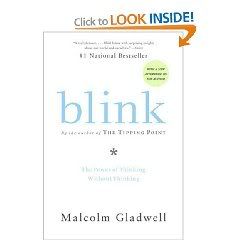
Best-selling author Gladwell (The Tipping Point) has a dazzling ability to find commonality in disparate fields of study. As he displays again in this entertaining and illuminating look at how we make snap judgments—about people's intentions, the authenticity of a work of art, even military strategy—he can parse for general readers the intricacies of fascinating but little-known fields like professional food tasting (why does Coke taste different from Pepsi?). Gladwell's conclusion, after studying how people make instant decisions in a wide range of fields from psychology to police work, is that we can make better instant judgments by training our mind and senses to focus on the most relevant facts—and that less input (as long as it's the right input) is better than more. Perhaps the most stunning example he gives of this counterintuitive truth is the most expensive war game ever conducted by the Pentagon, in which a wily marine officer, playing "a rogue military commander" in the Persian Gulf and unencumbered by hierarchy, bureaucracy and too much technology, humiliated American forces whose chiefs were bogged down in matrixes, systems for decision making and information overload.
I often hear an interview with an author or read a review of a book that sounds terrific, only to learn when I read the book that I learned about all I need to know from the interview or review. Unfortunately BLINK fits that category although Mr. Gladwell does make some interesting observations that fall into the sad, the fascinating and the obvious.
It is sad, for instance, that in the year 2005 we are still programmed by racial stereotypes when we blink. The shooting of Amadou Diallo is an unfortunate example. Police officers see a small black man on the street after midnight in a bad neighborhood in the Bronx. When they drive by him he does not run. Then he finally runs, attempting to get into his apartment and reaches for somethig that turns out to be a billfold. We know how this incident ended. Mr. Gladwell goes into great detail to explain all the mistakes that the polices officers made. For instance, if they had paid attention to his face they would have seen that he was frightened rather than dangerous. It is incredibly sad that in an experiment where black college students, when given twenty questions taken from the GRE, the standardized test for admission to graduate school, if asked to state their race on a pretest questionnaire, the number of questions they would get correct is cut in half, they are so programmed by negative racial stereotypes. (Congressman John Lewis has spoken out recently on racial profiling at airports.)
Some of Mr. Gladwell's facts are fascinating. Shoppers will pay more for the same amount of ice cream if it is packaged in a round rather than a rectangular container, for instance. Then there is the Pepsi v. Coke taste test. Fanatics swear they can tell the difference, and many drinkers can. However, if you do the triangle test, where you put the same cola in two glasses and the other in the third glass and ask a thousand samplers to tell you which two colas are the same, only about a third of the testers gets it right. That, according to the author, is not much better than chance, so we might as well guess.
Many of the author's observations and conclusions are obvious: what he calls the Warren Harding error-- that we often vote for attractive political candidates regardless of their qualifications; and that tall white men get promoted over black men, white women, black women and short white men; and that blinking or "thin slicing" is more accurate if it involves something we care about and are good at, i.e., we have experience in the area. He gives example after example of this: the psychologist who through years of study can predict from a short interview with a young couple- even if they are just discussing a pet-- if they will get a divorce down the road; the art critic who spotted an expensive fake immediately because she had studied ancient sculpture, the seasoned tennis pro who can predict when tennis players will miss their second serve.
The Seventeenth Century philosopher Pascal is way ahead of Mr. Gladwell since he said something similar a long time ago: chance favors the prepared mind.
Publication Manual of the American Psychological Association
If you have any need to write in APA, this book is a must. This is the standard by which your work will be judged. If you are not familiar with APA format, you may find this book very unwieldy and confusing at first. A great way to get started is to just open it to page 306-320, which is a sample paper written and formatted in APA style. Each salient feature is denoted with a comment balloon referring you to the applicable section of the guide. This simple technique should get you started.
Many people complain about the overabundance of seemingly useless and needless information. However, I feel that the completeness of the guide is its strength. The guide deals with every facet of the a concern in a very thoughtful, complete way. Sometimes I find myself laughing at the completeness that the guide gives a particular topic, but at times when I am seeking to answer a specific formatting, grammar, or organizational question, I am extremely thankful for that completeness.
This book is indispensable, one of my most-referred-to reference materials. If you are writing an APA style paper for a class in school and won't ever need to use it again, go to the public library at borrow it. If you will be writing often, you should definitely buy it. No matter what, don't write an APA-style paper without it.

 Posts
Posts
