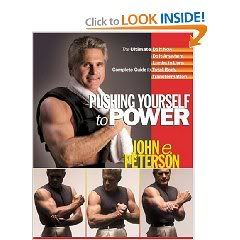
I've been meaning to write a review of this book from some time, but I wanted to wait until I had a chance to really work with the exercises. A little background on me (since anyone thinking of buying an exercise book wants to know: Will it work for a guy like me?) I am ready to turn 45. I am what you might call a weekend athlete. I play hockey in a league here. I have never been a world-class athlete or body-builder, but I've never been horribly out of shape, either. I take care of myself. Don't smoke, drink a little, and watch what I eat. I'm in pretty good shape. I am not as trim as I was in High-School, but I don't have much of a gut. I am 6'2" and about 200 pounds. So, kind of middle of the road physique-wise. I am a reader, so I have read all kinds of books on fitness and bodybuilding, and buy Men's Health every month (damn, I could save some money with a subscription, come to think of it!). I know about every theory you can name. (If only knowing were the same as doing!) Last year, I joined a local fitness club. After three weeks, I felt a difference. My body tightened up nicely. My waist trimmed. I looked better in clothes, and my wife appreciated the difference out of them. I wasn't bulky big. But the difference was noticeable. I felt good. But, you know how it is... you have a job, a wife, two kids... Getting to the Gym is hard when you are also designated Kid Taxi. I stopped going... lost my definition, put on some weight, and was pretty disappointed in myself. Enter Push Yourself to Power (PYPT). I've been working out with it for a couple of months, and the gym results are back - even though I haven't darkened the door of any gym. That's very cool! Is it magic? Are you kidding? No exercise program is. And buying it won't make you any fitter, any more than buying a Tae-Bo DVD will trim inches off of your waist-line. Unfortunately, you actually have to use it to see a benefit. But it does work. There are, however, a couple of things that you have to know... because this exercise program won't work for anyone. The beauty of the system is that you don't have any weights. The problem of it is that you don't have any weights. Let me explain: When you lift a 25 pound weight, two things work together: The weight offers resistance, and your muscle provides the effort. This will make your muscle work hard and which eventually leads to muscle breakdown. Your body, being incredibly smart, rebuilds the muscle better - seeing that it now needs more strength. This is the basis of all body-building theory. Your body builds what it needs. If you eat potato chips and sit on a couch, it doesn't need muscle. If you work digging ditches, it does. The body adapts. Weight training, essentially, fools your body into thinking it needs to develop efficient muscles to exist. So it does. So, resistance + effort = growth. In normal weight lifting, you provide half of the equation: Effort. In PYTP, you need to provide BOTH the effort AND the resistance. And that is the challenge. If you are lazy, this will not work for you. You can be lazy and get results with lifting weights. 25 pounds is always 25 pounds, whether you are fired up and ready to go, or tired and wishing you were in bed. It always takes 25 pounds of effort to lift it. But with PYTP, you have to provide the 25 pounds of resistance with one muscle so you can reap the benefit of 25 pounds of effort with the other. This is where the "Pushing" part comes in. If you are unwilling to push yourself, you will get a lame workout, and get no results. That is the challenge... But, there is a tremendous upside to this: You see, if you do a set dumbbell curls you pick a weight that you can lift 8 or 10 times. The problem is that your muscle has different needs at the beginning of a set than it does at the end. If I can curl 50 pounds 8 times, that means the first couple of reps are too easy for my bicep, whereas the last couple are actually too hard. (And these last reps can actually be a problem... because your muscle is breaking down and getting weaker, the stress of the weight is now being partially borne by your joints and tendons... this is how "lifting" injuries can occur. It isn't just bad technique... sometimes it is simply working with a weight that is too heavy...) Now imagine lifting a dumbbell that magically changed resistance as you went. So it was heavier for the first couple of reps when you start out, and got lighter as your muscle fatigued. If this were possible, you would get a better, and safer, workout. That's the theory behind PYTP. And, if you focus and concentrate, you can achieve this. But, there is another drawback to no weights, and that is: No measurement. If I bench press 180 pounds for a week, and then move up to 200 next week, I can MEASURE my improvement. But this won't happen with PYTP. My resistance and effort will change daily. I will never be able to see that my right arm is now stronger, because it is being resisted by my left arm which is now proportionally stronger, too. In fact, it will FEEL like exactly the same workout. Other than the fact you can see your arms are bigger, you won't notice a difference. Of course you can set up measurements that you do once a week. Maybe go to a gym and test yourself. Or see how many pull-ups you do, or whatever. For me, I don't care. When I was in high school, the question of: "How much can you bench?" came up often... but it never does any more. No one cares in my world. All I want to do is play hockey, take care of my family, and spend time with my wife. I want to look "good" and feel good. I don't want to run out of steam at the end of the day, and I don't want my body breaking down too soon as I age. I measure strength differently these days. There is one HUGE advantage to PYTP that should be mentioned: It can be done anywhere. Last week, I was watching a hockey game on TV, and thought: "Wow, it's Tuesday...I need to workout today." Ordinarily this would mean either blowing off the workout, or turning off the game, grabbing the keys, and heading to the gym. (Guess which one usually won...?) But, now it meant simply standing up, and starting. I got a full workout in, while watching the game. That is such a great feeling! OK... so that's how I feel about the "theory". What about the book? First of all, I view PYTP as more of an encyclopedia of exercises than a routine. Beginners may be frustrated by this. If you want "here's how you start" type of advice, you should get PYTP with something like the Miracle 7 or Powerflex - both of which have more routines, and fewer exercises. There is a website, which is very cool. And John Peterson is actually involved in the website. I don't know of many other places were you can post a question for the author, and actually get an answer from him (usually in less than a day). Now, be forewarned, many of the answers boil down to: "You need to do what feels right to you and your body" but usually other guys on the board will also chime in. John is about as non-pushy as I've ever seen. If you are looking for the drill sergeant type approach: "Do this now you maggot!" you're not going to like Bronze bow website. But it is a great add-on for the book. And I have been amazed at the tone of the site. Even when some guys come on and try to start a flame war, the mods and author simply smooth things over without resorting to flaming back. It's a very "gentlemanly" site. (Though a few women do post, I am speaking of the classy tone...) There is also a chapter on nutrition, but I don't think anyone is going to have a huge epiphany after reading it. The South Beach Diet is a good book for anyone who needs a diet. And there are better books on nutrition in general (some from Bronze Bow as well). But, I don't think John considers himself a nutritionist, anyway. The goal-setting and life/time management chapter is fairly thin, too. If you want to read on this more (and it is worth reading) I highly recommend: "10 Natural Laws of Successful Time and Life Management" by Hyrum Smith (founder of Franklin Time Management). Best book I've ever read about it. There are some chapters on John's heroes. It's OK, but, to be honest, I wasn't overly inspired. It might be nice if someone would do a rewrite... maybe one of those guys who writes those tear-jerking stories in Reader's Digest. As prose goes, I didn't find PYTP inspiring. But then again, I didn't buy it for that. There has been a lot of comment on the "Christian" tone of the book. I have a few thoughts on that... First, if you read any martial arts book, you will be inundated with the "Zen" philosophy, and eastern religion... but I've never seen a reviewer in the martial arts books even comment on it. Why is the fact that John is a Christian so irritating to so many reviewers? Personally, I'd much rather have a guy come right out and proclaim what he believes so I know where he is coming from. And it's not like each exercise starts out with a Bible verse. Basically, you can skip his chapter on his personal beliefs and go straight to the exercises. It's not a big deal. Unless you're looking for something to be offended about... Over all, I really like this book. The pictures are good, the descriptions accurate, and it gives you what you need to get in shape - and stay in shape - no matter how busy your schedule is.
Showing posts with label sport. Show all posts
Showing posts with label sport. Show all posts
A-Rod: The Many Lives of Alex Rodriguez
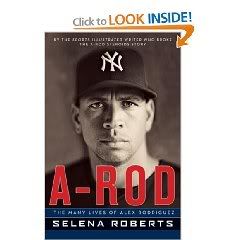
The real story is about A-Rod. Roberts' painstaking investigative reporting of the highest-paid, most talented player in baseball over the course of nearly a year is revelatory. First, she broke the biggest story in sports by outing Rodriguez as a steroid cheat during the height of his career. With this book, she has filled in the narrative. "A-Rod: The Many Lives of Alex Rodriguez" is more than the salacious snippets reproduced in the New York tabloids, it is a study of a flawed hero searching for self. A-Rod, like many baseball stars, germinated in the steroid era, aided and abetted by self-interested father figures who pretended they could fill the hole left by the original. In many ways, Alex Rodriguez is the protagonist of a Greek tragedy. Roberts has provided the exposition; it's up to A-Rod to write his denouement.
The Yankee Years

I liked the book because I like baseball and Yankee gossip and personal tidbits. It also filled in some holes about why they let Pettitte leave; the process leading to casting off Bernie; and the steps leading to Torre's estrangement with Brian. I also remembered much of the things that Joe talked about. The book confirmed my judgment that management does play an essential role - and that Joe needs to be blamed for much of the perceived [they were in the playoffs each year and did have the winningest record in baseball] failures his last 6 years, just as he got credit for much of the successes his first six years. As a CPA consulting with clients on managing their businesses, I found gems in this book that could be applied to most any organization. Joe talks about the team's desperation to win in 1998. My most successful clients have that desperation - obsession - commitment - to succeed. It is manifested in everything they do and with every contact they have. That single minded focus - ferocious will to win - elevates the entire organization feeding more success upon each success. It is a feeling of entitlement to winning. Teammates so focused with the shared vision serve to compliment managers using peer analysis, advice and pressure to keep straying members in line. Age plays a role in sports and an aging Yankee team couldn't cut it. I advise on management succession planning. Throughout the book Joe talks about the ages of his players - some of the later teams lacked a succession plan to younger players with the older guys holding on longer than they should - with the one guy they should have kept being discarded in a disrespectable way. Business continuity depends on it as do professional organizations. The Yankees' lack of an effective pipeline from their farm system and the utter failure with their draft picks stunted the internal growth that would have applied the proper training and development into the organization's culture. The Moneyball technology and information systems brought new ways to assess players and assemble teams. The last to adopt these are usually the [previously] most successful of the group, feeling that they don't need to change their ways; and when they do it is with a catch up mentality with shortcuts and perceived arrogance that they are probably not as good as the old ways. That is the way it seemed with the Yankees and Cashman's use of the new systems. This is one part of the book where Joe blames others for the team's failures and I agree with him. Joe tried to apply a human element to the analysis and it was rejected. It seemed to me that Joe was right - and if he wouldn't have been right, it couldn't have been worse. An example is his analysis of why he wanted to keep Bernie while Cashman's "numbers" showed that a Mientkiewicz and Phelps combination would be far superior. Coincident to the IT systems is the application of new ideas and energy. This was illustrated with the story of how Boston signed Curt Schilling from under the Yankees. Also supporting this is the low days lost to players on the disabled list by the Cleveland Indians in 2007 versus the very high number of days lost by the Yankees. Aggressive new approaches. A favorite story I tell clients is The Emperor's New Clothes. That is a simple tale of perception and how people can be influenced by others. Joe's discussion of the myth of the benefits of free agency is a perception fallacy. The book tells of the system's inefficiency where a team overpays for a great payer slightly past his prime with talent guaranteed to decline over the life of the contract. Also the teams with overblown payrolls like the Yankees subsidize the lower rung teams who are better able to lock in younger lower paid players with long term contracts removing them from availability until they reach just past their prime. Joe places a high value on trust following set rules. Without them you can't have discipline and order and an effective organization. I have nothing to add to this - this is the way it is. When Joe wrote about Cashman's seizing control of the baseball operation he described the methods everyone should follow when they introduce new ideas. Prepare a clearly defined memo stating everything you want and why, and the benefits to the organization. Be thorough and complete. Address every item that might come up and give your considered analysis. Put it in a way where the only response is a "Yes" or a "No." Unless you are living in a dream world, you will get what you want. I personally have been very successful with this technique, and have also used it to help clients innumerably. Joe says that preparation and training are essential to winning. My successful clients work the hardest, prepare the most and practice to improve their weaknesses. A thought that comes to mind is when Chesley Sullenberger landed his plane safely in the Hudson River and he gave great credit to his training. Without the right amount of preparation, practice and training there cannot be consistent long term success. The management aspects of the book shouldn't be passed over. Joe Torre took over as manager of an unsuccessful franchise and under him they appeared in the playoffs every one of his twelve years at the helm, winning four World Series. He was given a team to manage that he didn't choose and had to use somewhat unfavorable resources to produce winning results. Management does matter and there is a lot in his book that can be applied to every type of business and organization.
Subscribe to:
Posts (Atom)

 Posts
Posts
