Showing posts with label politics. Show all posts
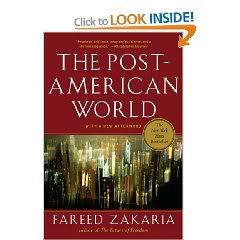
The Post-American World
"This is not a book about the decline of America, but rather about the rise of everyone else." So begins Fareed Zakaria's important new work on the era we are now entering. Following on the success of his best-selling The Future of Freedom, Zakaria describes with equal prescience a world in which the United States will no longer dominate the global economy, orchestrate geopolitics, or overwhelm cultures. He sees the "rise of the rest"—the growth of countries like China, India, Brazil, Russia, and many others—as the great story of our time, and one that will reshape the world. The tallest buildings, biggest dams, largest-selling movies, and most advanced cell phones are all being built outside the United States. This economic growth is producing political confidence, national pride, and potentially international problems. How should the United States understand and thrive in this rapidly changing international climate? What does it mean to live in a truly global era? Zakaria answers these questions with his customary lucidity, insight, and imagination.
Mr. Zakaria has written a short primer (250+ pages of text) about where the world is today and the role he sees the United States playing in the future. His assessment, for the most part, is fair, balanced and nonpartisan. And though the title of his treatise--The Post-American World--sounds pessimistic, in reality Mr. Zakaria sees the glass half full.
The principal weakness of the book is a product of its brevity: the author paints in broad strokes, providing a sweeping assessment of the dynamic changes that have unfolded on the world scene over the past twenty-five years. This invariably results in some over-generalizations and assessments that are not sufficiently nuanced. For example, in responding to concerns about China's growing power and influence, he quotes several Chinese officials who repeatedly reassure the listener that, notwithstanding its recent advances, China still lags behind the United States in so many areas; consequently, it poses no real threat to America or its neighbors. Instead of taking these sentiments at face value, Mr. Zakaria should remember, as Margaret Macmillan astutely noted in her recent book, "Nixon and Mao: The Week That Changed the World," that the Chinese are the past masters at using self-effacement to lure their adversaries into a state of complacency.
The greatest strengths of the book are explaining to the reader how much the world has changed over the past 25 years (did you know that China now exports more goods and services in a single day than it did in all of 1978?), while illuminating the course corrections the United States needs to make so that it can continue to influence the evolution of globalization. I was surprised to discover that the simple truths taught by Adam Smith have lifted more people above the poverty line in the last 25 years (400 million in China alone) than all the government assistance programs of all the countries in the world since the beginning of time. But I was dismayed to learn that the polices of free trade, liberal immigration, technological change and open government that are the source of this global revolution are no longer warmly received in the United States. Mr. Zakaria notes that in 2007 the Pew Global Attitudes Survey polled citizens in 47 countries for purposes of measuring the extent to which they have positive views about free trade and open markets. Guess where the U.S. came in? Dead last. Mr. Zakaria observes that in the five years the survey has been done, no country has seen as great a drop-off as the United States. It's as if, he says, that for the past sixty years we have extolled the virtues of free markets, immigration, technological change, competition, and democracy, and now that the rest of the world has finally decided to take our advice, "we are becoming suspicious of the very things we have long celebrated." (p. 48).
If you want to look in the mirror and see the warts and disappointments, along with the beauty and promise, of America, read this book. You and our country will be better for it.
http://www.fareedzakaria.com/books/index.html
Labels: books review, history, politics, The Post-American World
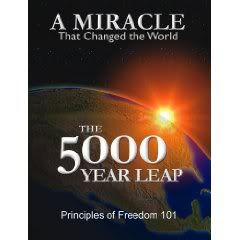
The 5000 Year Leap: A Miracle That Changed the World
This is an incredible book that should be read by all Americans. I first read this book back in the mid 1980s shortly after it was first published. It had such a profound effect on me that I can still recall where I was when I was reading it. That is rather amazing as I have I have probably read about 1600 books since then. I was excited to see that it had recently been republished as my original copy is pretty ragged. It was great to reread it and brush up on the great ideas contained in it. The premise of the book is that because of the free market system that took root after our Constitution was enacted, the United States literally made a 5000 year leap of progress in the time since then. The author, W. Cleon Skousen, discussed the changes from the time of the founding of Jamestown in 1607 to the early 1980s when the book was written. In discussing Jamestown, he said: "The most striking thing about the settlers of Jamestown was their startling similarity to the ancient pioneers who built settlements in other parts of the world 5,000 years earlier. The whole panorama of Jamestown demonstrated how shockingly little progress had been made by man during all of those fifty centuries." He went on to say, "The settlers of Jamestown had come in a boat no larger and no more commodious than those of the ancient sea kings. Their tools still consisted of shovel, axe, hoe, and a stick plow which were only slightly improved over those of China, Egypt, Persia, and Greece. They harvested their grain and hay-grass with the same primitive scythes ..." He then discussed the Constitution that was developed by the Founders. It took 180 years for them to put it all together from the beginning of Jamestown in 1607 to the enactment of the U.S. Constitution in 1787. He goes through the inspirations and sources for their thoughts in explaining how the U.S. Constitutional system came about. Dr. Skousen contrasted the situation described in Jamestown above to the present day. He talks about the phenomenol results produced by the free enterprise system. Some of the incredible inventions and changes that he cites are as follows: the internal combustion engine, jet propulsion, exotic space travel, 'all the wonders of nuclear energy', massive changes in communications, the doubling of the life expectancy, central heating/air conditioning, surgical miracles, cures for numerous diseases, etc. Needless to say, the list could go on and on. In showing how our system was designed, Skousen goes through 28 principles that the Founders developed from their study of sources such as Cicero, Locke, Montesquieu, Adam Smith, and others. Skousen has done what most people don't have the time or inclination to do: Study the original source materials and bring it all together. Obviously, it would be great if every American studied the sources listed above as well as The Federalist Papers, the writings of Jefferson, Franklin, Madison, and others. Since that is unlikely, this is a great way to gain a good general understanding of the roots of our nation. One great thing about this book is that the author discusses some of the problems that we have faced in recent years due to failing to follow the Constitution and the principles of the Founders. Some of these are issues like the mounting national debt, excessive taxation, and judicial activism. Dr. Skousen also does a great job of explaining the political spectrum and the absurdities of the left-right labeling so often used in discourse today. He explains in an easy-to-understand manner that the far left and far right as the terms are used today are really the same thing, ruler's law, and are totally out of step with the way the system was intended. One could easily go on about this book for a long time, but I will spare the reader that. Suffice it to say, this is an amazing book that should be read by all. I would also highly recommend, "The Making Of America" The Making of America: The Substance and Meaning of the Constitution by the same author. Anyone who reads those two books will know more about the way our system was designed and supposed to work than 99% of all Americans including 'constitutional lawyers'.
Labels: 5000 Year Leap, best-seller, politics
Servant: The Acceptance
Gabrielle Cody has accepted her destiny as God’s warrior, charged to destroy all evil, but she wasn’t prepared to see Detective Luther Cross ever again. He’s the beacon of reality in her life, the one thing that makes her feel human, like a real woman.But Gaby must resist involvement with Luther now, for she is protecting streetwalkers. Her life of retribution is far too dangerous, and this time, it’s not just their hearts that won’t come out unscathed.
Labels: best seller, books, lori foster, mystery, politics, romance, servant : the acceptance
Subscribe to:
Posts (Atom)
