Countless historians have written about the accidental or noninevitable nature of the American Revolution. The story bears repeating for Americans have enough trouble remembering what happened in their own lifetimes let alone 225 years ago. In the capable hands of Joseph Ellis the miracle of the founding is once again brought to life. As he did in Founding Brothers: The Revolutionary Generation, Ellis takes another look at the achievements and the failures of the founding of the republic.
Ellis admits that his version of the founding is not very au courant with academic history departments. Here the founders have been reduced to dead white males who were "racists, classists, and sexists, a kind of rogues gallery of greats." Nor does he subscribe to the other extreme view, that the founders were demigods who created the republic through some masterstroke of divine inspiration.
The reality was that the founders were exceptional, but not without their flaws. Rather than one continuous narrative, Ellis has written seven essays dealing with certain pivotal events between the formative years of 1775 and 1803.
In the tradition of the "great man" school of history, Ellis chronicles certain key moments in American history as they were being acted out by famous individuals. Very different from, say, Howard Zinn's People's History of the United States: 1492 to Present (P.S.), a victim's history of America. We have Washington and the Continental army at Valley Forge; John Adams during the writing of the Declaration of Independence; James Madison and Patrick Henry at the Constitutional Convention, etc. The triumphs are well-known even to a forgetful country.
The tragedies that Ellis speaks of (to which Zinn devoted his entire book) were the failure to abolish slavery and to come up with a "truly just Indian policy."
The issue of slavery was never resolved because the Southerners at the Constitutional Convention threatened not to ratify unless slave-holding rights remained intact. Looking the other way was the only way the founders could get the new charter ratified. The issue festered for many years until it was abolished by the belated and bloody Civil War.
Ellis also has an excellent chapter on the negotiations between War Secretary Henry Knox and the charismatic Indian leader Alexander McGillvray. They were unable to consumate a peace treaty because their respective constituencies rejected the terms of the agreement.
Both tragedies were the product of the newly created and imperfect democracy. Southerners did not want to end slavery and Westerners did not want to allow the Indians any land. It was the tragedy of a democracy in which not every person had the right to vote.
If 1775 to 1803 was the time of American Creation, the years 1786 to 1788 were the most consequential. The debate between James Madison and Patrick Henry during the Virginia Ratifying Convention on federal and state's rights left open the question of which would have supremacy. The question is still open and the debate is still going on. The tension between state and federal government remains one of the most distinctive virtues of American government. Madison argued that government should not have the answers, but provide a forum for the debate. Now that's revolutionary.
American Creation
American Gospel
It is a well researched book about the influence of religion in American government. His premise is that the Founding Fathers created a kind of "public religion" in the words of Benjamin Franklin. The public religion was not specifically Christian, but broad enough to cover the Christian, the Jew, and the Deist. The Founding Fathers were classically educated as well. Annuit Coeptus is a paraphrase from Virgil. The Founding Fathers had a greater variety of religious beliefs than we realize. I find much truth in some of the ideas of Jefferson and Franklin, neither of which would be considered orthodox Christians in their time or ours. I think Thomas Payne offers some good ideas, too.
Christianity was more divided at the time of the revolution than it is today, and the importance of the differences was considered greater. One thing that is hard to recognize today is that not only was there a certain animosity toward Jews, or even Catholics, but the Protestant sects considered their differences important. In 1774, there was opposition to prayer in the Continental Congress, inspired in part by the Episcopalians' fear that having everyone join in a prayer would tend to treat all the religious traditions as equal.
Many of the quotes we usually hear in debates whether the United States is a "Christian" nation are given here, but what is particularly useful is that they are put in context. It does little good to say Washington said this and Jefferson said that in the abstract, without knowing what they were talking about.
Frequently there are references to people who worship twenty gods, or no gods being treated equally. In fact there were few who worshipped no gods then, and probably fewer who worshipped twenty. The point was made, however. There were also references to the ideal that the Muslim would be just as free to worship as anyone else (I think an amazingly impressive foresight in a country that had few if any Muslims).
It's hard to pick and choose from the book. In a way, it's so objective that more will find fault with it than do not. That's probably a sign of a good objective overview.
The main problem I see with the book is there's too little perspective of what it has meant to be pluralistic or secular in the context of the rest of the world. At the time of the American Revolution, a state without an official religion was a strange concept. The way of the world had always been that the government was run by a King who ruled by the grace of God, and in return protected God's true religion from heretics and blasphemers. Now in large parts of the world democracies in which people are more or less free to worship as they please are at least the aspiration, if not the reality, in most of the world. America was unique in creating and sustaining a state without an official link to a particular religious tradition.
Today, I think much of the world has passed us up. Today, Franklin's public religion has been replaced by a generic Judeo-Christianity where we are lucky, and a doctrinaire narrow fundamentalist Christianity where we are not. The doctrinaire Christianity does not seem to me to have much to do with the teachings of Jesus of Nazareth, but I've ranted about that before. It is true, however, that it is always hard work to maintain freedom, including freedom of religion. Preserving that freedom is a job that will never end.
This book may not be the definitive word on the subject, but it's balanced and well-researched. It's something that one should take into account before asserting that America is either a Christian nation or a godless one.
The Post-American World
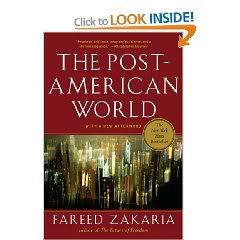
"This is not a book about the decline of America, but rather about the rise of everyone else." So begins Fareed Zakaria's important new work on the era we are now entering. Following on the success of his best-selling The Future of Freedom, Zakaria describes with equal prescience a world in which the United States will no longer dominate the global economy, orchestrate geopolitics, or overwhelm cultures. He sees the "rise of the rest"—the growth of countries like China, India, Brazil, Russia, and many others—as the great story of our time, and one that will reshape the world. The tallest buildings, biggest dams, largest-selling movies, and most advanced cell phones are all being built outside the United States. This economic growth is producing political confidence, national pride, and potentially international problems. How should the United States understand and thrive in this rapidly changing international climate? What does it mean to live in a truly global era? Zakaria answers these questions with his customary lucidity, insight, and imagination.
Mr. Zakaria has written a short primer (250+ pages of text) about where the world is today and the role he sees the United States playing in the future. His assessment, for the most part, is fair, balanced and nonpartisan. And though the title of his treatise--The Post-American World--sounds pessimistic, in reality Mr. Zakaria sees the glass half full.
The principal weakness of the book is a product of its brevity: the author paints in broad strokes, providing a sweeping assessment of the dynamic changes that have unfolded on the world scene over the past twenty-five years. This invariably results in some over-generalizations and assessments that are not sufficiently nuanced. For example, in responding to concerns about China's growing power and influence, he quotes several Chinese officials who repeatedly reassure the listener that, notwithstanding its recent advances, China still lags behind the United States in so many areas; consequently, it poses no real threat to America or its neighbors. Instead of taking these sentiments at face value, Mr. Zakaria should remember, as Margaret Macmillan astutely noted in her recent book, "Nixon and Mao: The Week That Changed the World," that the Chinese are the past masters at using self-effacement to lure their adversaries into a state of complacency.
The greatest strengths of the book are explaining to the reader how much the world has changed over the past 25 years (did you know that China now exports more goods and services in a single day than it did in all of 1978?), while illuminating the course corrections the United States needs to make so that it can continue to influence the evolution of globalization. I was surprised to discover that the simple truths taught by Adam Smith have lifted more people above the poverty line in the last 25 years (400 million in China alone) than all the government assistance programs of all the countries in the world since the beginning of time. But I was dismayed to learn that the polices of free trade, liberal immigration, technological change and open government that are the source of this global revolution are no longer warmly received in the United States. Mr. Zakaria notes that in 2007 the Pew Global Attitudes Survey polled citizens in 47 countries for purposes of measuring the extent to which they have positive views about free trade and open markets. Guess where the U.S. came in? Dead last. Mr. Zakaria observes that in the five years the survey has been done, no country has seen as great a drop-off as the United States. It's as if, he says, that for the past sixty years we have extolled the virtues of free markets, immigration, technological change, competition, and democracy, and now that the rest of the world has finally decided to take our advice, "we are becoming suspicious of the very things we have long celebrated." (p. 48).
If you want to look in the mirror and see the warts and disappointments, along with the beauty and promise, of America, read this book. You and our country will be better for it.
http://www.fareedzakaria.com/books/index.html
Nixonland: The Rise of a President and the Fracturing of America
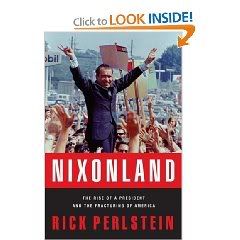
Perlstein uses the rise of Richard Nixon as a way of illustrating the rise of modern Republicanism, with its populist themes, often faux populist policies, and its relentless negativity. None of these things were invented by Nixon, his circle, or the GOP, but he certainly provided a vehicle for making them central to Republican power since the 1960s. Although Nixon is the central figure of the book, Perlstein also provides a narrative that describes what happened to the Democrats and how they came to fall out of power, even as a majority of voters tended to endorse the majority of their positions.
The book is not a full scale biography of Nixon and some sections show obvious signs of editing which probably excised details that would be important to people not familiar with Nixon's life or major events of the 1960s. The book also relies a lot on secondary sourcing and could have used more aggressive fact checking on key details (e.g., Hugh Scott did not represent Ohio, Wayne Hays was not from Cleveland and, most embarrassingly for a resident of Chicago's South Side like Perlstein, the Dan Ryan Expressway goes no where near the West Side. Perlstein also goes with less credible accounts of Eisenhower's decision to place Nixon on the ticket (Eisenhower wanted Earl Warren) and the sweep of Eisenhower's disdainful treatment of his vice president (e.g., waiting until the last minute to endorse him in 1960) is not fully developed. The phoniness of Nixon's striving also gets a bit lost. Nixon was a poor relation (his mother's family were the local gentry), but never knew real poverty--unlike Lyndon Johnson, who shared many of Nixon's grievances about the world, or George McGovern whose view of life was more optimistic than that of Nixon or Johnson.
The book's these is built around drawing distinctions between the Franklins (the privileged people of ease, people not unlike Nixon's mother's family) and the Orthogonians (strivers, people w/o privilege). These two groups were names of social clubs at Whittier College in Nixon's day. Nixon is credited with organizing the Orthogonians, although some historical accounts suggest the group was already in existence when Nixon came to college. Perlstein notes how Nixon tended to view people in terms of whether they fit one or the other of theses clusters throughout his life and how he built his political appeal around identifying with the Orthogonians (and carefully concealing his admiration for and financing by the Franklins).
Nixon, of course, is not the only Orthogonian president we've had---Truman and Johnson come to mind (and only get eliptical recognition, as such, in the book). The current George Bush would like to see himself in that mold and many would put Jimmy Carter in that category, as well. While this is helpful in seeing Nixon's world view and the construction of various populist appeals within the GOP, Perlstein misses some of the important subtleties of the Orthogonians. For one thing, there are earnest Orthogonians (McGovern, Carter) and people like Nixon (or Johnson). Some people strive, while others embellish and cut corners along the way and both kinds of Orthogoninas thrive with sponsorship. Nixon and, especially, Johnson made much of slim war records, neither could be considered "clean campaigners", and both had less than honest retainers and sponsors. Nixon also tended to embellish his Orthogonian credentials, as in the exaggeration of his childhood "poverty". Another is that while people may identify with the struggles of an Orthogonian leader, their appeal is easily lost, and the public seems to abandon them pretty readily. Perlstein's repeated looks at Nixon's popularity suggest that much of Nixon's peak support was soft and a glimpse at history would suggest that the most Orthogonian figures in the presidency seem to be the ones whose support evaporated the most readily (Truman, John, Nixon, Carter, and Bush II), perhaps because their pettiness showed through easily or because strivers have more difficulty in providing inspiration, especially when they have the many character flaws embodied by Nixon (social awkwardness, paranoia, etc.). People may have liked Nixon, in a pitying way, but he never inspired the kind of admiration or inspiration of Franklin's like John Kennedy or Franklin Roosevelt. Nixon's genius was attracting likeminded people who have continued to stage manage GOP campaigns into the present and helping to construct the narratives that proved so successful for them. OTOH, he lacks a legacy in terms of a mass movement of admirers or even hagiographers. The more earnest Orthogonian seems more capable of redemption, as in the case of Jimmy Carter, but it has required decades of painstaking work to accomplish this (or the earnest efforts of historians, as in the case of Truman's redemption), as opposed to the ease with which a Kennedy could inspire.
The book will dishearten liberals with rose colored eyes toward the 60s (or a lack of first hand experience of that era). The sheer political ineptitude of George McGovern is on full display, along with the shortsighted worldviews of the people who came to cluster around him. The pathetic, if zany, state of the New Left in 1972 is another problem for liberals, along with the lack along with the lack a real vision of how the disorder of the era affected the general public. Even so, Perlstein has difficulty pulling the strands of his book together and, instead, it ends in a rather clumsy, blunt way. Part of the problem is George McGovern. He was, if anything, as Orthoganian as Nixon and a far more decent, modest man. Also, it's apparent that if the Democratic "Orthogonians" such as Richard Daley or George Meaney had had their way, the candidate would have been someone like Hubert Humphrey (presented in all his hammy desperation), who easily could have lost to Nixon by a decisive margin. Moreover, despite their disarray at the national level, the Democrats were far from dead closer to the grassroots and the GOP had its own problems--Nixon had virtually no coattails in 1972. Another problem is that Perlstein fails to identify how the great mass movements of the early 70s--the environmental movement and the women's movement cut themselves off from their own receptive mass constituencies and became increasingly Franklin-like, a perspective that would have helped his overall thesis and provided a better prelude to the Reagan years. The women's movement quickly turned to intramural politics and abortion rather than economic issues, while the environmental movement became a captive of earnest college types who had little appreciation of how to confront the obvious environmental hazards experienced by less well off Americans. Perlstein also tends to exaggerate the appeal of Nixon to union members (as part of an obvious build up to a future book on Reagan which I'm sure will talk about "Reagan Democrats") and fails to put George Meany's role in the '72 election in context. Meany was able to exercise more power than in the past (or future) because of the then-recent death of progressive United Auto Workers' president, Walter Reuther, who had been close to many liberal politicians. Meany had long been viewed as a cretin by many trade unionists, but he had achieved significant power at the AFL-CIO despite never having spent much time on the shopfloor; like Nixon he was a corner cutting, nasty Orthogonian. In contrast, rank and file unionists have proven to be less likely to vote Republican than other parts of the stereotyped "Reagan Democrat" demographic.
Like Perlstein's Goldwater book, this one makes clear that the current Conservative movement is very much the product of people now entering their twilight years. Implicitly, this also makes clear that no figures of comparable intellectual or organizational imagination is in positions to take their place. Nixon saw himself as basically a center-right politician and despite occasional use of the term conservative to describe his outlook, he was far too pragmatic and utilitarian to be a movement conservative, although his authoritarianism would fit well with contemporary conservative postures. Nixon actually feared the Right (something which Perlstein misses) and viewed movement conservatives with the same withering eye as he did liberals, although he lacked the obsessions about the Right that haunted him with respect to liberals.

 Posts
Posts
