Showing posts with label religion. Show all posts
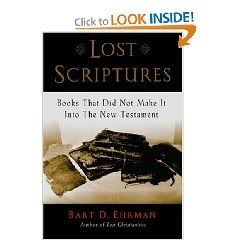
Lost Scriptures
While most people think that the twenty-seven books of the New Testament are the only sacred writings of the early Christians, this is not at all the case. A companion volume to Bart Ehrman's Lost Christianities, this book offers an anthology of up-to-date and readable translations of many non-canonical writings from the first centuries after Christ--texts that have been for the most part lost or neglected for almost two millennia. Here is an array of remarkably varied writings from early Christian groups whose visions of Jesus differ dramatically from our contemporary understanding. Readers will find Gospels supposedly authored by the apostle Philip, James the brother of Jesus, Mary Magdalen, and others. There are Acts originally ascribed to John and to Thecla, Paul's female companion; there are Epistles allegedly written by Paul to the Roman philosopher Seneca.
This book contains 17 non-canonical gospels from a variety of sources, as well as five books relating to activities of the apostles, 13 non-canonical letters (epistles), seven apocalypses and revelations, and five different canons, all of which were superceded by the Council of Nicaea under Constantine's guidance.
These, in other words, were ancient Christian books that Constantine's scholars saw fit to view as heresies, or did not include in the Council's version of what constituted "true" scripture for whatever reason.
The author holds the chair of religion at the University of North Carlina at Chapel Hill, and has translated many of the works himself. He is a recognized, respected scholar in his field.
Although this is a book for laymen in that it reads easily, and is bereft of the usual scholarly jargon, the individual gospels, letters, and acts, etc., are often murky and hard to make sense of.
I think it is because we are unfamiliar with the idioms in use at the time they were written, and the culture from which the writers sprang.
For example, today, to indicate anger in our culture, many people use the uncouth, course phrase "pissed off." That language is tantamount to Aramaic in the beginning of the current era, which then was the language in common use by the people in the Holy land. In a thousand years, our language will have evolved as it has continually in the past. It will be interesting to see how scholars, translating writings from today that use the term will translate the phrase which, although we use it to indicate mild anger, actually will translate to something to do with urination.
And so it goes.
It is therefor difficult to understand the intended meaning behind many of the parables and sayings deriving from the time these materials relate to.
As someone once said, relating to English speech, "Two negatives
can make a positive, but two positives cannot make a negative."
Yeah, right!
This is a good book if you have any interest in the ancient's Christian non-canonical writings, and have an open mind on the subject. If your mind is closed and you are perfectly content with Constantine's version of orthodoxy (the Bible as it is), you should probably give this book a pass, as it will no doubt incur your hostility and accuse the author, a true scholar, of having an agenda, or being of suspect parentage--which would be unfair, of course.
On the other hand if you have a background in religious history and want a source for these books, these are excellent translations and it is a good book for your library.
http://www.questia.com/PM.qst?a=o&d=103177594
Labels: best books, books review, Lost Scriptures, religion
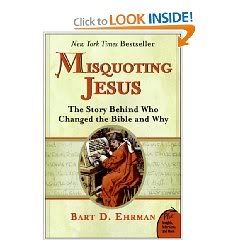
Misquoting Jesus
This is the first book of Ehrman's I have read. I found it interesting and well-written for the average person who has little background in Biblical Textual Studies, (which equates to more than 99% of the population.)
I do not have the credentials of Dr. Ehrman, but I do have the equivalent of a degree in Biblical Literature and have worked in the original languages. My Senior Thesis was doing a textual comparison of the Gnostic Gospel of Thomas discovered at Nag Hammadi with the parallel passages of the Kingdom Parables of Matthew 13. To do that I had to teach myself some Coptic Egyptian and do some translating to form a basis for comparison.
All that said to establish that I have some background to make an evaluation of what is being said in this book.
I also have some common ground with Dr. Ehrman in life history. I too was trained as an evangelical with a very high view of inspiration and further had to struggle as I became aware of how difficult it is to interact with the text in its manuscript and historical form all while becoming painfully aware of the fact that any view of inspiration must tacitly admit that it is a hypothetical basis of faith because as Ehrman states clearly:
1. If the original manuscripts are inspired, we don't have them.
2. What we do have, while overall reliable and fairly easily examined for error, still leaves some serious questions of textual manipulation by scribes that makes several key passages difficult to stand upon for important doctrines.
This is, in fact, not as great a secret as Ehrman seems to imply throughout his book. There are a great number of books from all backgrounds and degrees of belief that acknowledge these types of issues. Granted, they tend to be more of an academic nature than what Ehrman has attempted to do here. But they are there nonetheless and have been for centuries.
Jefferson's Bible was an early example (though not necessarily intended for distribution at the time) of how people wrestled with this issue. The means of wrestling with them have improved with additional manuscripts discovered (i.e. the Dead Sea Scrolls and Nag Hammadi to name the better known ones.) Scholarship has improved to where I believe it is safe to say that what we know in this realm today has improved our confidence in most areas of the text.
In fact, the newer translations themselves (The NIV, the NASB etc.), actually have margin notes and some variant readings noted very clearly in just the areas that Ehrman focuses on within his book. That hardly equates to a "cover-up."
In view of this, I think Ehrman somewhat oversteps his points in favor of salesmanship to try and press home his own doubts that have arisen in his personal journey. Most Christians have many tools, books, websites, and Bibles themselves to be introduced to these types of issues (IF they want to be.) This is an issue well within the grasp of the average layman if they should be interested in pursuing it.
There are many conservative scholars with equally distinguished academic backgrounds that match Ehrman's and yet still maintain a higher view of Scripture than he appears to have adopted. I accept that his views are well informed and sincere. I do not accept his conclusion that inspiration of the original text requires equally divine preservation. However, in recognizing that I accept that the onus is on those of my persuasion to provide solid scholarship to demonstrate our case. I believe that is being provided. I would encourage any reading this book to listen to what Ehrman has to say and do some research on what others of a more conservative approach and respect for Scripture have to say as well. In this regard, even Bruce Metzger, Ehrman's mentor to whom he dedicates the book has a somewhat more conservative view and conclusion based on the same criteria.
The primary and most valuable point that I think Ehrman makes in this work, is that there are many Christians in denial either through ignorance or worse, perhaps an unwillingness to face these issues for fear of upsetting their internal house of cards and being forced to admit that there are unanswered questions and room for some intellectual honesty and humility in facing difficult issues related to the Bible.
There are many Christians, unfortunately who prefer denial to honest appraisal. Ehrman very rightly confronts this with his material.
As an evangelical who has retained and maintained his faith in this journey, I haven't found it necessary to resort to denial. There are satisfactory answers to be found. It does, however, require a willingness to adopt some humility and to honestly rethink and modify positions when the facts call for it. That is not a bad thing. In fact, I think it's a good thing and results in a deeper, more understanding, more relevent and intellectually honest faith that can move and interact within our society and culture without apology. I don't believe God intends for his people to be mental midgets or follow their faith mindlessly.
That having been said, I didn't find the text offensive or threatening for that matter. I think he does a good job of raising the points on the major issues without overly sensationalizing them beyond what I have qualified above. His facts are reasonably sound and accurate, even if they are somewhat selective. His conclusions in places seem to be somewhat hastily arrived at, but I'm willing to give him some latitude due to his goal of making this easily grasped by the average person with no formal training.
Worth the read. Hopefully any reading this as an introduction to the field will not stop here but go on to explore and learn more. Metzger is good, Gordon Fee is good. FF Bruce also has some good material, but there are many others if you want to enter the field more deeply and see some differing persepctives.
Evangelicals, (such as myself) need to read and interact with these types of books and enter the field as participants in the debate rather than naysayers throwing verbal salvos from behind our walls of faith, security and (unfortunately at times) ignorance.
Read it and be introduced into an important field of knowledge.
http://www.allaboutworldview.org/misquoting-jesus.htm
Labels: all about books, books review, Misquoting Jesus, religion
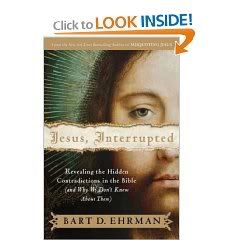
Jesus, Interrupted
Picking up where Bible expert Bart Ehrman's New York Times bestseller Misquoting Jesus left off, Jesus, Interrupted addresses the larger issue of what the New Testament actually teaches—and it's not what most people think. Here Ehrman reveals what scholars have unearthed:
The authors of the New Testament have diverging views about who Jesus was and how salvation works
The New Testament contains books that were forged in the names of the apostles by Christian writers who lived decades later
Jesus, Paul, Matthew, and John all represented fundamentally different religions
Established Christian doctrines—such as the suffering messiah, the divinity of Jesus, and the trinity—were the inventions of still later theologians .
If you are a fan of Bart D. Ehrman like I am, there are four books essential to understanding his work. The first is Jesus: Apocalyptic Prophet of the New Millennium; the second, The Orthodox Corruption of Scripture (popularized in his book Misquoting Jesus); the third is God's Problem where he argues that the problem of evil is what caused him to lose his faith; and this one, "Jesus Interrupted."
In a way I like "Jesus Interrupted" the best, probably because its aim is to reach the masses with solid Biblical scholarship. I've long thought that scholars mostly talk to themselves in hopes for a nice pat on the back from other scholars. Don't get me wrong here. We need scholars, and Ehrman is one who writes good scholarly material too. It's just that Ehrman also wants to inform the masses about what Biblical scholars have known a long time, but which pastors and ministers aren't telling their parishioners for fear that they might be troubled to learn about it. And Ehrman is a master communicator of it when it concerns the New Testament, which is his specialty.
According to Ehrman this book is about how "certain kinds of faith--particularly the faith in the Bible as the historical inerrant and inspired word of God--cannot be sustained in light of what we as historians know about the Bible." (p. 18). He begins by describing the difference between a vertical reading of the Gospels (Matthew, Mark, Luke and John) with a horizontal reading of them. A vertical reading is simply taking one Gospel at a time and reading through it. A horizontal reading, however, is where we place the gospels side by side and read them together to see the differences in the accounts. When we read the Gospels horizontally we find discrepancies, irresolvable differences, and even contradictions, not only in the small details, but also when it comes to major ideas presented by the authors.
Some of the minor discrepancies are as follows: Mark differs with John on which day Jesus died (of this Ehrman writes, "I do not think this is a difference that can be reconciled." p. 27); there are significant differences between Matthew and Luke concerning various aspects of the birth of Jesus, as well as the irreconcilable genealogies found in their stories. Other discrepancies concern things like what the voice from heaven said at Jesus's baptism, what Jesus did the day after his baptism, whether or not Jarius's daughter was already dead when her father approached Jesus; who is for and against Jesus; how long Jesus's ministry lasted; why Judas Iscariot betrayed Jesus along with how he died, and the irreconcilable differences in the resurrection accounts of Jesus.
Ehrman also asks us to read Paul's writings horizontally with the book of Acts to compare them. When we do there are even more problems: after Paul's conversion did Paul go directly to Jerusalem?; Did the churches in Judea know Paul?; Did Paul go to Athens alone?; How many trips did Paul make to Jerusalem?; Were the congregations Paul established made up of both Jews and gentiles?
There are major discrepancies as well, like the depictions of Jesus's death in Mark, where Jesus dies in agony and despair, from Luke where Jesus seems oddly in control of the situation. There are differences in the Gospel of John from the other Gospels with regard to Jesus's teaching content (long discourses versus proverbs and parables), emphasis, eschatology (which is emphasized in Mark but deemphasized in John) and the purpose of miracles (which in contrast to the other Gospels in John they're meant to convince people who don't believe).
Ehrman informs us there are also key differences between the apostle Paul and the Gospel writers: concerning the purpose of the Law; why Jesus died; when Jesus became the Son of God; whether God overlooked the ignorance of idolaters; and whether the Roman state is a force of good or evil.
To keep this review of mine short let me briefly summarize the rest of the chapters. In chapter four Ehrman tells us scholars really do not know who wrote the New Testament, except a few letters from Paul for the most part. In chapter five Ehrman discusses what we can actually know about the real Jesus and what he may have said, which isn't much given the criteria historians use to figure out such things. At best Ehrman argues that Jesus as an apocalyptic prophet. And he thinks that as a historian he cannot conclude Jesus arose from the dead because such a conclusion is beyond what tools the historian has at his disposal. Chapter six discusses how we got the Bible. It was a lengthy process from oral tradition to translations, to texts, to canonization among wildly divergent early Christianities all vying to be considered the inheritors of the original Jesus movement. Who invented Christianity then, which is the subject of chapter seven? Christians did, based upon misinterpretations of such texts as the Suffering Servant in Isaiah 53. Christianity subsequently moved in the direction of a distinct anti-Jewish movement in the hands of Gentile Christians.
In the final chapter Ehrman disarms the believer, which I think is a very helpful thing to do. He thinks it's still possible to believe despite the problems in the New Testament. And he's right. Although he says that what he's learned about the Bible makes it look like nothing more than a human, not a divine book, and that Christianity is a human, not a divine religion.
Ehrman concludes his book with these words: "It would be impossible...to argue that the Bible is a unified whole, inerrant in all its parts, inspired by God in every way. It can't be that. There are too many divergences, discrepancies, contradictions; too many alternative ways of looking at the same issue, alternatives that often are at odds with one another. The Bible is not a unity, it is a massive plurality. God did not write the Bible, people did." (p. 279).
While this conclusion of his will be disputed, what Ehrman has written must be taken seriously by all Christian believers. The arguments are now out in an easily accessible book. As such, the people in the pew can now understand what Biblical scholars in most seminaries already know but are too timid to teach it in the churches or preach it from the pulpits.
http://www.harpercollins.com/books/9780061863271/Jesus_Interrupted/index.aspx
Labels: best books, books review, Interrupted, Jesus, religion
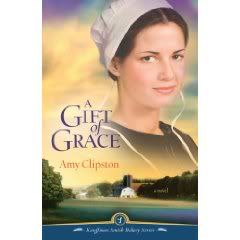
A Gift of Grace
Imagine yourself a typical teenager of today, with your cell phone and Ipod, going to high school and looking toward college. With almost no warning, you are suddenly whisked away to an Old Order Amish community, with no electricity, telephones, or automobiles.
New Zondervan author Amy Clipston explores that premise in the first book of her "Kauffman Amish Bakery Series." After receiving an advance copy of A Gift of Grace from[...] to review for this week's blog tour, I can't wait for the second installment!
When Rebecca Kauffman's "English" sister and brother-in-law are killed in a traffic accident, Rebecca's two teenaged nieces come to live with her in her Lancaster County Amish community . Unable to have children of their own, Rebecca and her husband Daniel now have an "instant family". While one sister acclimates quickly to the Old Order culture, the other rebels at the unwelcome restrictions. Rebecca finds herself torn between abiding by her sister's wishes that the girls be raised in the culture she rejected and her husband's insistance that the girls will never fit in and in fact threaten the Kauffman's place in the community.
Rebecca's struggle to honor her sister's memory and provide a loving home for her nieces in the face of her husband's strong disapproval is heart-wrenching. The way Clipston chose to resolve that struggle was not what I expected...and I liked that. At times in Christian fiction...even good Christian fiction...the ending is rather predictable. It was a pleasant surprise to find I didn't have this one figured out from the start. :)
Clipston writes about difficult issues and emotions without coming across as "heavy". When God's will and our plans collide, the results are often painful, but A Gift of Grace spotlights the hope that comes when we stop fighting His plan, and instead embrace it. Clipston says, " Sometimes we may be convinced God has forgotten us or that what we're experiencing isn't part of His plan. However, things may not go the way we'd hoped, but God is always in control. " She speaks as one who has experienced trials...her family is currently awaiting her husband's second kidney transplant, about which she says, "God has been teaching me a whole lot about having patience and giving my burdens up to Him... It's been a very long and difficult road with my husband's illness, but prayer and faith have been my companions."
Labels: A Gift of Grace, best-seller, books, religion
The Love Dare
Half of all marriages end in divorce. That means most marriage relationships are either severely dysfunctional or headed that way. What is the answer?
The Love Dare's answer is that we don't really understand how to live out the love that marriage requires. Inspired by the movie Fireproof, this book is a forty day devotional that covers various aspects of the true sacrificial love which is missing from many marriages.
There is a lot to like about this book. It clearly explains the nature of mature love & practically challenges you to live it out. It emphasizes how YOU have to be the one to take responsibility and change, regardless of how your partner does or does not respond, and it shows how the strength for that kind of love is powered by a relationship with God through Jesus Christ. This book has had a powerful impact on thousands of people, and I am very thankful for the truth it teaches.
However, the book does have some shortcomings. First, the book is unnaturally constrained to fit the plot of the movie. The movie's plot confronted the main character with his need for a personal relationship with God mid-way through, and so the book follows suit. Halfway through the forty days, we suddenly shift to a presentation of how living out sacrificial love should make one realize his absolute need for Christianity. For Christians reading a book on marriage, the discussion of how our relationship with Christ should structure our marital relationship should be foundational, should be page 1. On the other hand, a non-Christian reading the book frankly is unlikely to be impressed by this sudden foray into an altar call in the middle of the book.
Second, the book spends little time on the differing roles of the husband and wife in a marriage. From a Biblical standpoint, there are real & crucial differences in how a man loves & responds to his wife vs. how a woman loves & responds to her husband. The Love Dare doesn't address these differing roles which are very important to the success of any Christian marriage.
Third, I felt there was this unwritten "if you do these steps your marriage will be transformed" aura to the book. While all marriages can benefit from going through this devotional, I think that many seriously troubled marriages will not have the movie's storybook happy ending at the end of forty days. Consequently, I fear people will either conclude they failed in some way or that God failed in some way. Neither would be true. Many marriages need more than just a good devotional; they need intensive personal intervention by a person of wisdom such as a counselor or pastor plus two partners who are both committed and humble. In my experience true humility is seldom found in both halves of a troubled relationship.
The Love Dare is forty days of wisdom and challenge that will benefit any marriage; just don't consider it to be the complete cure-all for every troubled relationship in the world.
The Shack
The Shack" is a one of a kind invitation to journey to the very heart of God. Through my tears and cheers, I have been indeed transformed by the tender mercy with which William Paul Young opened the veil that too often separated me from God and from myself. With every page, the complicated do's and don't that distort a relationship into a religion were washed away as I understood Father, Son and Holy Spirit for the first time in my life. --Patrick M. Roddy, ABC News Emmy Award winning producerFinally! A guy-meets-God Novel that has literary integrity and spiritual daring. "The Shack" cuts through the cliches of both religion and bad writing to reveal something compelling and beautiful about life's integral dance with the Divine. This story reads like a prayer--like the best kind of prayer, filled with sweat and wonder and transparency and surprise. When I read it, I felt like I was fellowshipping with God. If you read one work of fiction this year, let this be it. --Mike Morrell, zoecarnate.comWhen the imagination of a writer and the passion of a theologian cross-fertilize the result is a novel on the order of "The Shack." This book has the potential to do for our generation what John Bunyan's "Pilgrim's Progress" did for his. It's that good! --Eugene Peterson, Professor Emeritus of Spiritual Theology, Regent College, Vancouver, B.C.
In brief: by "lacks balance," I mean it needs more truth mixed with the wonderful elements of grace, more active faith mixed with the relational elements of love. It is heavy on conversation and light on action; heavy on God's "soft" qualities and light on His "hard" qualities; heavy on fantasy and light on reality; heavy on explanations and light on mystery. A better balance of these would have made a better novel. My first response to the idea of someone trying to depict the Trinity in a novel is, either they're a fool or they're really bold. I mean, "Fools rush in..." and all that. The Trinity is the greatest mystery of Christendom. To include it in a novel as three of its characters, you would have to understand it pretty thoroughly, right? But what human has that kind of understanding about the things of God? William Young thinks he does. Second, if you substitute a human being for God the Father - "a large beaming African-American woman" (p. 82), in this case - you're stripping Him of His divine nature and all that goes with it. No matter how wonderful that human is, and even though we're created in God's image, you are substituting an image of God for God. That is, at worst, idolatry, according to the second commandment; and, at best, a huge let-down. Third, you're also stripping God of His mystery by trying to explain and understand Him. We're not supposed to understand God. That's why He is God and we are His creatures. As someone once said, "To explain something, you have to be greater than the thing you want to explain." I wouldn't want to be the one presuming to be able to explain God, would you? I have a feeling God is standing behind Young with a look on His face that would cause Young to turn sheepishly red if he turned around. Now, someone is going to say, "The Shack is an allegory. It's not supposed to be taken literally." Chronicles Of Narnia is an allegory. Pilgrim's Progress is an allegory. The Shack is not. To be an allegory, a work of fiction has to be "an extended metaphor: a narrative in which objects, persons or actions have meanings that lie outside the narrative itself." Papa might be considered an allegorical character if it weren't for the fact that he/she is called God and thought of as God, literally, throughout the novel. No, even though The Shack has strong elements of fantasy, which allegories often do, it is more along the lines of The Da Vinci Code: a novel that attempts to redefine God. In The Shack, William Young errs the way Randy Alcorn, in The Grace And Truth Paradox, says most Christians err: he makes a choice between grace and truth - two things that are supposed to be taken together, and both of which Jesus came to bring (John 1:17). Young chooses grace over truth, even though it takes both to be Christ-like. He chooses a forgiving Father over a disciplining one, when Scripture says that God is both. He chooses the God he wants over the God who is. He chooses a buddy. Not only that, Young seems to divide God into two genetic halves: one male and the other female. He discounts the male half with all its "vices," and embraces the female half with all its "virtues." He does this in a number of ways, not the least of which is how he depicts Papa, the name one of his characters gives to God the Father. All of God's harder, or "male," character qualities - warrior (Exodus 15:3; Jeremiah 20:11), refuge (II Samuel 22:3; Psalm 46:1), disciplinarian (Hebrews 12; II Timothy 1:7), jealous lover (Exodus 20:5; Zechariah 1:14), avenger and judge (Nahum 1:2; Hebrews 10:30), to name a handful - are either ignored or denounced. The softer, or "female," qualities - love, grace and mercy, for example - are exalted. Young makes all the strong characters in his novel female, and all the weak ones male - except for Jesus, maybe. Papa (God the Father), Sarayu (the Holy Spirit), Sophia (Wisdom), Nan (wife of Mack, the main character), the FBI agent "Sam," and even MIssy (Mack's daughter) are all strong females. Mack, his buddy Willie, Mack's father, the "Little Ladykiller," and police officer Tommy are all either weak or highly flawed males. Young even goes so far as to condemn men in general on pages 146-148, saying that, because women are more relational, they would have made better leaders than men and, if that had happened, "there would have been far fewer children sacrificed to the gods of greed and power." I guess he just forgot about the role women have played in abortion in America - something that has killed far more of its children than all the wars in its history combined. That is the problem with transferring our own prejudices to God: it blinds our eyes and gives our prejudices "justification." I find this "preference for the feminine" in The Shack to be very similar to Dan Brown's penchant for goddesses in The Da Vinci Code. Then Young goes on the warpath against nations in general, and America in particular, denouncing everything from power and authority to institutions and economics - even patriotism. Are we to infer from that that he prefers nihilism and communism over godly order and republican democracy? It isn't clear because he doesn't give any practical examples. If he truly is condemning all governments, systems and institutions, then he condemns people like William Wilberforce, George Mueller and Mother Teresa - saints who worked within governments, systems and institutions to make life better for the poor and weak. In condemning armies, weapons and warfare, he condemns the men and women who have given their lives for freedom, - including the heroes of the Bible, our founding fathers, the heroes of WWII and our present military overseas. Instead of condemning those things wholesale, Young should have differentiated between those that are of this world, or of the evil one, and those that are of God. God also has power, authority, institutions, armies, weapons and warfare. Young seems to ignore these. Something else that bothers me is how the author wants us to deal with our problems magically, in Alice-In-Wonderland or Matrix fashion - through dreams, visions or phenomenal events - rather than realistically and maturely through prayer, faith and discipline. He seems to believe that everything can be fixed with a hug, a treat and a cup of coffee. Eating and talking, relationally - as opposed to doing what's right, no matter how difficult it is - seem to be his solution. Love, as he defines it, is preferred over prayer, faith and discipleship - things that take work. Love and relationships are important - very important - but not to the exclusion of righteousness, or doing what's right. Often God calls on us to take a stand and fight - spiritually, mentally and sometimes physically - rather than hold hands and sing "Kumbaya." Just a cursory study of Jesus' life shows that. There is so much good in The Shack, and it starts off so well, that it is really a shame it goes down a rabbit's hole once Mack gets back to the shack. It held so much potential, which a more mature writer would have known what to do with. For example, it could have turned into a really good spiritual thriller. Instead, it becomes a series of didactic conversations. I did like the chapter with Sarayu in the garden, and with Sophia in the cave. Notice that every chapter is basically just a conversation - nothing really "happens" at the shack. Yet, notice how much does happen in the first four chapters. They are the part of the book that is most like real life and, therefore, most believable. If only the whole book could have been that real, that believable. I was especially disappointed in the walking-on-water chapter with Jesus. Young turns what was a miracle that caused the disciples to shake with awe into a neat little magic trick. Which brings me to this point: where is the awe, the reverence that is always evident in any conversation with God in the Bible? Even the disciples were continually in awe of Jesus. Psalms 111:10 says that the fear (awe, reverence) of God is the beginning of wisdom. Where is that at the shack? Mack should have been falling all over himself with wonder and awe, fear and reverence - which would have added another rich layer to the book. Instead, he has an unexplainable non-chalance about the whole thing. There should have been equal amounts of awe and wonder to go with the warm, fuzzy feelings. For a first novel, I think Young does a decent job writing; but he bites off far, far more than he can chew subject-wise. It is obviously biographical, and I would say that Mack, not Willie, is the character that represents Young. He is obviously dealing with some issues from his past, which authors often do in their first novel. But I'm not happy with the way he deals with them. A wound received in childhood from a father can only be healed through another father-like relationship - not through a relationship with "a large beaming African-American woman." Even though a strong, "male" Father God could fill that role and heal that wound, He would also choose to work through people - so there should also have been one or more strong male characters in Mack's real world that came into his life and befriended him. That's the way it happens in real life, as God designed it. For what it's worth, The Shack is a promise of what could be done if a writer followed the encouragement of CS Lewis: "We don't need more people writing 'Christian books' [but] what we need is more Christians writing good books." What that says to me, in light of The Shack, is "we need better writers with better theology writing better stories; not more writers writing more stories with more theology." A good goal to continue shooting for.
Labels: best books, best-seller, books, books review, paul young, religion, spirituality, the shack
Subscribe to:
Posts (Atom)